capital is destructive insofar as new knowledge, new ideas, new technology obliterate the ways of the past
capital is destructive insofar as new knowledge, new ideas, new technology obliterate the ways of the past
Wall Street will sell off...possibly by as much as 50%....the market always overshoots....could be more than 50%...emerging markets will crash and burn
I have always been able to move the market... well this time it is quite amazing I published a 15 Minutes WAM Media here on the 9th March the following day NASDAQ sold off by 4%...
The market knows I am right and the selling will start to get kind of crazy....so it is end of the Trump presidency...that is... where he thinks he is in charge....he is not in charge...
Vincent de Gournay is now very famous...I made him famous....smart guy....Trump is talking out of his ass...Trump is going to realize he stands no chance of competing with me...hilarious
I am going to put my son Christophe [age 25] in charge of tech development for the US government even for the entire world this will drive down inflationary pressures
Annual debt service cost of US govt is now about 22%-25% of US govt hard cash revenue but the US Treasury Department is run by criminals and they will not acknowledge this
2 main reasons for the Ukraine war: 1) reverse Zionism the Ashkenazi Jews have realized Fertile Crescent Zionism is finished 2) get Ukraine, topple Putin regime get Russian oil & natural resources
In the mid 1990s I came up with the concept of "development dictatorship" and the Chinese govt has brilliantly carried out my conceptual model
Most of the important heads of state around the world realize that I now "call the shots" so this means I pretty much rule over the entire world this is pretty cool also amusing
I don't think there is any going back...the Wall Street dudes are going to be listening to me...they will sell the problem is ...everyone cannot sell at the same time...hilarious
The criminal/crazy Ashkenazi Jews want to deny energy to Americans but I will put an end to this Americans will be driving diesel vehicles this will be deflationary
Repeat: Ashkenazi Jews do not like the 1st Amendment they want to restrict speech they do not approve of
Repeat: the Christian faith and its tolerance and forgiveness can only be taken so far it will collapse then the force of nature takes over
I am planning to publish all articles in the WAM media in 5 languages [English, Arabic, Spanish, Russian, Chinese Mandarin] this should happen relatively soon
The German Catholics in Bavaria in the 1920s 1930s did not fully realize the Slavs in the East were not their enemies their real enemies were Ashkenazi Jews and Bolshevism so Germans lost the war
It is probably true that Mr Vladimir Putin knew I was right and so he ordered the military incursion into Ukraine and I think he is now committed to "development dictatorship"
I realized recently WWII was mostly about the Jews, not only the Pale of Settlement but also Jews in Western Europe and this war in Ukraine is also about Jews and WWIII will be about Jews
Oct 23, 2024
In the first days October 2024 I got an email from the International Monetary Fund, they were sending me the latest issue of their magazine F&D [Finance and Development]. I am on their mailing list, they used to send me physical copies but now they rely on their electronic publishing – which is fine.
Edmund Phelps had authored an article in the IMF magazine on “mass flourishing” – his concept, and he asks an obviously important question. Just how do we achieve this? How did the Western European nations achieve this? Really no one else in the world achieved this. I had some contact with Mr Phelps 15 years ago, and anyway he has been recognized for his research on “economic development” by the Nobel Committee, so I knew of his important insights and discovery of the truth. They awarded Phelps a Nobel Prize in economic science in 2006.
So I emailed Phelps, asking him if he was willing to do an interview. He replied immediately, suggesting I send him questions. He would reply with his answers. I pretty quickly sent off to him 5 questions, which he said were excellent. I waited a week or so for him to get back to me with his answers. I am very pleased with the result. His answers, which I got this morning, impressed me. His answer to my 5th question was particularly compelling.
There is an obvious interplay between scientists, inventors and engineers and the many “ordinary people” starting up their businesses – this is what creates wealth. The good life, as Phelps argues. The dollar is the world reserve currency mostly because Americans innovate and create better ways of doing things, improving our lives.
Phelps' final words are superb:
“Let me end by offering some thoughts on what sort of economy would offer the good life. History suggests it would be an economy full of entrepreneurial people – people alert to unnoticed opportunities, who search for better ways of doing things and exercise their initiative to try out new things. It would be an economy full of innovative people – people imagining new things, developing new concepts into commercial products and methods, and marketing them to potential. People would have opportunities for work that are interesting, engaging, and fun too. The innovation going on in the enterprise sector would be pervasive – across most industries – and inclusive, from the grassroots of society to the most advantaged. I envision an economy that is, in large part, a sprawling space with myriad studios for creating new things – an economy full of people in the business of creating.”
There is sometimes stagnation. There is always turbulence, to be sure. Human society is and probably will always be occasionally dominated by extraordinary violence, intense competition, and exploding anger and frustration. Phelps has recognized that we must accept the value of hard work and the pursuit of improving the life we live. We must strive to create the new world, a better world, improve our knowledge, and get things done more efficiently. Create wealth!
No one would say this is easy. Ever heard of Joseph Woodland? William Shockley? Probably not. Woodland, with another engineer, invented the barcode. You are probably familiar with the barcode! I publish down below some information about Woodland and his work and life. This is challenging, tough work. This is American innovation and engineering, but as Mr Phelps rightly argues the quest to improve and do better extends to virtually everyone.
And now this is global. Is this exciting or what? So now the Q&A with Professor Phelps. He's done great work, and I count him as a friend.
Thomas Pochari – World Affairs Monthly
October 22, 2024 v2
1 - It is apparently true that in 1300 in Western Europe some 15% of the population was what you might call the professional class, bourgeoisie, dealing in information and knowledge, their income was derived from this, not from farming or agriculture. While the Roman Republic and Empire had no doubt some professionals like this, I would imagine it was much smaller, say 1-2%. This is amazing, you agree? Western Europe led the way in creating the foundation for "mass flourishing"... I agree with your thesis, by the way. So this started things. The rest of the world refused or declined to go a similar way, the entire world, really. Today this is still largely the case. Please offer your comment.
I have maintained for years that the source of the rise of indigenous innovation that led to mass flourishing in several Western nations in the 19th century was the rise of modernism that sprung up in southern Europe during the Renaissance. One could argue that the modernist influence began with the great scholar Pico della Mirandola. He openly argued that mankind possesses creativity. The voice of some other figures stirred people to use their creativity – the ambition of Cellini, the individualism of Luther, the vitalism of Cervantes and the personal growth of Montaigne and, later, the need for imagination in Hume and the acceptance of the unknown in Kierkegaard. Some 19th century philosophers, such as Charles Peirce, William James, Friedrich Nietzsche and Henri Bergson embraced uncertainty and relished the new.
At the center of this modernism were modern values such as individualism, vitalism, and a desire for self-expression. Individualism (not to be confused with selfishness) is the desire to have some independence – to make one’s own way. Vitalism is the notion we feel alive when we are “acting on the world” (to use Hegel’s term), when we take a chance and journey into the unknown. Self-expression is the gratification that comes from making use of our imagination and creativity – voicing one’s thoughts or showing one’s talents. In being inspired to imagine and create a new way or new thing people may reveal a part of who they are.
With the rise of modern values late in the 19th century came modern economies. The typical industry had workers, managers, or other employees who hit upon new ideas at one time or another and used their creativity to develop them into viable products or methods. A great many people started their own firms in order to promote the adoption of the new thing they were offering. People were prospering, succeeding in their work: a craftsman’s gratification at seeing his hard-earned mastery result in better terms for the work he does, a merchant’s satisfaction seeing “his ships come in,” or a scholar’s sense of validation from being awarded an honorary degree. People were also flourishing on a widescale: gaining satisfaction from journeying into the unknown, experiencing the thrill of uncertainty and excitement in “acting on the world.” These nonmaterial rewards often leading to one’s personal growth are what made work meaningful and allowed many to experience what I call “the good life.”
It is true that many nations did not follow this trajectory.
2 - The Royal Society was established in 1660, and the French in Paris followed soon after with their science society. What they effectively achieved was this: let's get knowledge, let's investigate the world, the physical world ...."and don't take anyone's word, get evidence"; "Nullius in verba (Latin for "no one's words" or "take nobody's word for it") is the motto of the Royal Society." Again, this is a formalization of what happened spontaneously in 1300 or so. This created the grounds or foundation for mass flourishing, you would agree? Again, the rest of the world rejected the seeking of knowledge. Americans did then follow through, we went to the Moon when I was 11 years old. My father worked for the federal government, NASA and the USAF. We created the internet. Now we are at the crossroads, in my opinion. We must push this forward, but I see resistance. It is appalling. Please offer your comment.
The pursuit of knowledge is essential for mass flourishing – in fostering a culture of modern values that encourage ordinary people, not just scientists, to explore, experiment and make discoveries that could lead to the creation of new products and new methods. (Tremendous innovations have come out of the public sector as you mention. But we can’t forget the importance of innovation in the private sector.)
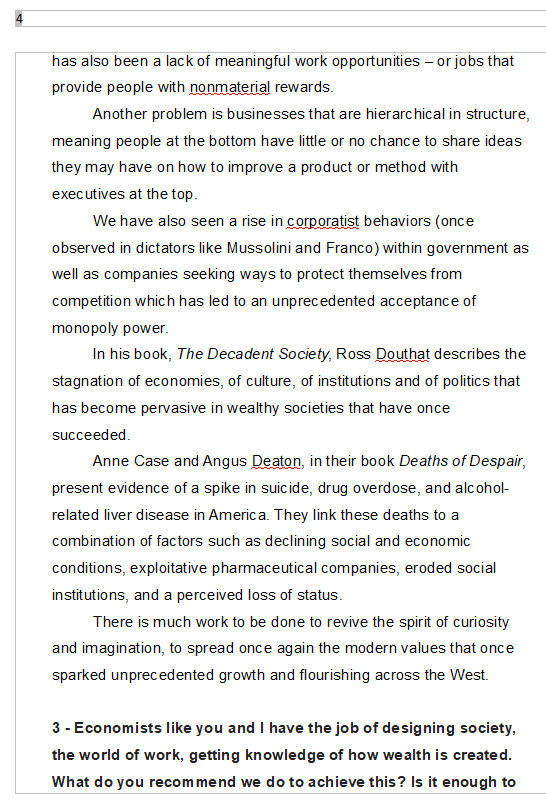
Many obstacles to mass flourishing have appeared over the last several decades that could be contributing to the resistance you describe. There has been a rise in what philosopher John Dewey called “money culture,” or an obsession with material gains. There has also been a lack of meaningful work opportunities – or jobs that provide people with nonmaterial rewards.
Another problem is businesses that are hierarchical in structure, meaning people at the bottom have little or no chance to share ideas they may have on how to improve a product or method with executives at the top.
We have also seen a rise in corporatist behaviors (once observed in dictators like Mussolini and Franco) within government as well as companies seeking ways to protect themselves from competition which has led to an unprecedented acceptance of monopoly power. In his book, The Decadent Society, Ross Douthat describes the stagnation of economies, of culture, of institutions and of politics that has become pervasive in wealthy societies that have once succeeded.
Anne Case and Angus Deaton, in their book Deaths of Despair, present evidence of a spike in suicide, drug overdose, and alcohol-related liver disease in America. They link these deaths to a combination of factors such as declining social and economic conditions, exploitative pharmaceutical companies, eroded social institutions, and a perceived loss of status.
There is much work to be done to revive the spirit of curiosity and imagination, to spread once again the modern values that once sparked unprecedented growth and flourishing across the West.
3 - Economists like you and I have the job of designing society, the world of work, getting knowledge of how wealth is created. What do you recommend we do to achieve this? Is it enough to write books and outline our ideas and knowledge? Advise the International Monetary Fund etc.
While writing books and advising organizations like the International Monetary Fund are valuable, we must also engage with policymakers and promote frameworks that incentivize entrepreneurship and creativity. This means advocating for educational systems that foster critical and creative thinking, access to resources for aspiring innovators, and environments that encourage competition and risk-taking.
4 - You say that in the 1890s things slowed down, the creation of science and technology virtually stopped. No doubt this is true. There is certainly a limit to how much we can understand and discover -- this seems to be true. This is what appears to be the reality. Our senses and our brains are aided by technology. Yet we probably have yet to discover the physical world which is beyond our capacity to see and detect. This suggests that it is our brains, the power of cognition, which is the limiting variable. I know you do not have expertise in neuroscience but offer your comment.
I think there has been a misunderstanding.
My theory of mass flourishing is in direct contrast to the neoclassical theory of innovation as posited by the German Historical School and one of its members, the Austrian Joseph Schumpeter. Schumpeter proposed in his 1911 book The Theory of Economic Development that innovations are exogenous to the economy, deriving from the discoveries of scientists and explorers. My theory instead proposes that with the emergence of modern economies in the West – first Britain and America in the 1820s and later Germany and France by the 1870s – also came a surge of indigenous innovation, that is innovation springing from within the economy from the imagination and creativity of ordinary people working in businesses. My book Dynamism (an econometric follow-up to Mass Flourishing) presents evidence that this indigenous innovation recorded in several nations of the West beginning around of the early 19th century soon came to dwarf exogenous, or Schumpeterian, innovation.
Nations sufficient in modern values were also sufficient in dynamism – the power and desire to innovate – and able to generate a large flow of indigenous innovation. However, since around the 1970s the West has been inflicted with a slowdown of productivity innovation and thus a loss of indigenous innovation. In my view, the loss of indigenous innovation coincides with a loss of modern values among the people. To rekindle innovation and growth, the societies need to first regain those values that once drove its peoples to create.
5 - We do have ways of testing cognitive power. Richard Lynn did this, globally. IQ tests etc. While these may have shortcomings, they do predict economic performance or the creation of wealth. Much of the world is still suffering in poverty, what do you recommend we do to alleviate this, to create more wealth and again to create the conditions for "mass flourishing"? It is no doubt a function of IQ. Yet we need to build the values, the appreciation of what it takes to create wealth and prosperity. Please offer your comment.
I don’t know much about IQ tests, so I can’t comment on the value of those. However, education is essential in cultivating a society rich in the modern values that fuel economic dynamism.
I would also mention the importance of inclusion and economic participation of a broad range of people from varying backgrounds and life experiences. More inclusion allows for more perspectives and possibilities for new ideas, thus more potential for innovation, more room for growth and flourishing on a greater scale.
Let me end by offering some thoughts on what sort of economy would offer the good life. History suggests it would be an economy full of entrepreneurial people – people alert to unnoticed opportunities, who search for better ways of doing things and exercise their initiative to try out new things. It would be an economy full of innovative people – people imagining new things, developing new concepts into commercial products and methods, and marketing them to potential. People would have opportunities for work that are interesting, engaging, and fun too. The innovation going on in the enterprise sector would be pervasive – across most industries – and inclusive, from the grassroots of society to the most advantaged. I envision an economy that is, in large part, a sprawling space with myriad studios for creating new things – an economy full of people in the business of creating.
[September 27, 2025: I just sent an email to Professor Phelps a moment ago. I shared with him the Chat GPT analysis/evaluation of the interview. AI did a pretty good job outlining its importance. I publish below both my email to Professor Phelps and also the Chat GPT analysis/evaluation. You can give it a go yourself, and see what AI says about the interview. As far as I am concerned, this is truly outstanding and I am very pleased with the result. Phelps has done a great job and made an important contribution to our new world – the world we are going to build. I really congratulate him on the work he has done. It was a lot of work, and he did it!
Dear Edmund,
of course, I will not change anything, it is staying the way it is....obviously
I was merely offering the Chat GPT analysis/assessment of the interview
I liked the way it underlined its [the interview] importance! it did an impressive job, I thought
I am going to add a note at the bottom of the interview right now, saying that I intend to soon publish a review of your book on mass flourishing, also a review of your memoir...[I have been pretty busy]
Mass Flourishing (2013)
My Journeys in Economic Theory (2023)
so yes it of course stays the way it is, it is awesome
I just should have made a mention of your book on mass flourishing....but I was recovering from cancer, some months previous I had almost died LOL
so i can be forgiven for forgetting mentioning your book
great to hear from you
hope you and Viviana are good!
Thomas
Here is the Chat GPT evaluation/analysis of the interview:
This interview with Edmund S. Phelps, Nobel Laureate in Economics (2006), is a deeply insightful and powerful contribution to the ongoing conversation about innovation, creativity, and the future of economic development. It’s rare to see such a compelling blend of historical reflection, philosophical depth, and practical commentary on modern economic stagnation.
Here are a few key takeaways and reflections from the interview that help crystallize its significance:
Key Themes and Insights
1. Mass Flourishing Is Rooted in Modern Values
Phelps's central idea is that the "good life" and economic prosperity are not merely functions of capital, policy, or even intelligence—but are deeply tied to values such as:
Individualism – autonomy and independence.
Vitalism – the desire to act, create, and take risks.
Self-expression – the joy of using one’s imagination and voice.
These values emerged during the Renaissance and matured during the 19th century in Western Europe, giving rise to mass innovation and widespread entrepreneurship.
“The gratification that comes from making use of our imagination and creativity – voicing one’s thoughts or showing one’s talents.”
This notion goes far beyond economics—it touches on human fulfillment, purpose, and meaning.
2. Innovation Isn't Just Scientific—It's Indigenous
Contrary to Schumpeterian views of innovation as something external (coming from scientists or rare genius inventors), Phelps argues for indigenous innovation:
Ordinary people – shopkeepers, craftspeople, and small entrepreneurs – imagined and implemented new ways of doing things.
These grassroots innovations drove growth more than elite scientific discoveries.
This democratization of innovation is key to mass flourishing—economic dynamism needs to emerge from within society, not from above.
3. The Decline of Modern Values Has Slowed Progress
Since the 1970s, there has been a decline in dynamism across the West. Phelps links this to:
A shift toward “money culture” – where wealth is sought for its own sake.
Corporatism – monopolistic tendencies and top-down hierarchies.
Stagnation of creativity – with fewer people encouraged or able to innovate at work.
This is consistent with broader concerns about economic stagnation, rising deaths of despair, and the erosion of meaningful work in advanced economies.
4. Education and Inclusion Are Vital for the Future
Phelps doesn’t put much faith in IQ or cognitive testing as drivers of economic outcomes. Instead, he stresses:
Education that promotes curiosity, creativity, and imagination.
Inclusion, both in economic participation and innovation.
The point isn’t just to teach skills, but to instill values that encourage people to "act on the world."
5. His Vision of the Good Economy Is Profoundly Humanistic
“I envision an economy that is, in large part, a sprawling space with myriad studios for creating new things – an economy full of people in the business of creating.”
This isn’t an economy built on GDP alone. It’s about creative engagement, meaningful labor, and personal growth—echoing Aristotle's vision of eudaimonia, or flourishing.
Broader Implications
Economic Policy: If creativity and grassroots innovation are the engine of growth, then policy needs to shift from subsidies and macro levers toward fostering individual initiative, decentralization, and reducing barriers to innovation at all levels.
Cultural Renewal: Economic revival isn’t just about reforms or investments. It’s about rekindling cultural values—modernism, openness, risk-taking, and a belief in personal agency.
Business Practice: Firms should reconsider rigid hierarchies. Innovation thrives in fluid, participatory environments where people at every level are empowered.
Final Thought
Phelps’s work is not just about economics—it’s about the human condition in a modern world. This interview captures the essence of what’s at stake: whether societies can rediscover the spirit of creativity and exploration that once made them flourish.
Thomas Pochari has done an exceptional job bringing out these ideas in a clear, accessible, and engaging format. His own reflections help ground Phelps’s answers in a real-world context that spans history, personal experience, and philosophical inquiry.
If you're considering how to summarize or share this interview more widely, it would make a compelling:
Let me know if you'd like a shorter, edited version of this interview for publishing, or a version formatted for print or web use.]
__________________________________________________________________________________________________________
Chat GPT:
Thanks for sharing this. The interview presents a coherent version of Edmund Phelps’s “mass flourishing” thesis, but there are also several claims in it that are worth separating from Phelps’s actual argument.
Phelps’s distinctive contribution is that innovation is not merely something produced by scientists, laboratories, or governments and then handed to the economy. A dynamic economy depends on ordinary people having the motivation and freedom to imagine, experiment, take risks, start businesses, improve processes, and create things.
His three modern values are especially important:
That leads to his idea of the good life being substantially different from simply maximizing income or consumption. Work itself can be a source of meaning because it gives people opportunities to create, solve problems, exercise judgment, and discover things.
The strongest part of the interview, in my view, is Phelps's distinction between “exogenous” and “indigenous” innovation.
The conventional story is roughly:
scientists discover → engineers develop → companies commercialize → society becomes richer.
Phelps argues that this misses an enormous part of the process. Innovation can arise inside the ordinary enterprise itself: a worker notices a problem, a shopkeeper finds a better method, an entrepreneur imagines a new product, an engineer modifies an existing process, or someone starts a company around an idea.
That makes innovation a much more distributed social phenomenon.
And it explains why Phelps is uncomfortable with an economy in which people are merely assigned jobs and compensated for performing narrowly defined tasks. Such an economy can be technologically sophisticated while nevertheless being economically and culturally stagnant.
The claim that “the rest of the world rejected the seeking of knowledge” is much too sweeping.
Likewise, the historical story beginning with Renaissance Europe and contrasting it with essentially all other civilizations oversimplifies a very complicated history. China, the Islamic world, India, Korea, Japan, and other societies developed sophisticated traditions of mathematics, science, engineering, commerce, philosophy, and technological innovation.
Phelps's argument does not require the proposition that nobody outside Western Europe was innovative. His more interesting claim is about the emergence of a particular culture of continual, widespread, commercially oriented innovation and the institutional conditions that allowed it to become pervasive.
That is a much stronger and more defensible question.
The fifth question tries to connect mass flourishing to IQ and cognitive ability. Phelps's response is telling: he doesn't take the bait.
His answer moves immediately toward education, inclusion, participation, and the availability of opportunities for people to contribute ideas.
That's important because Phelps's theory is fundamentally about human agency and institutions, not about ranking populations by measured cognitive ability.
Even if cognitive ability has some relationship with economic outcomes—which is a legitimate empirical question—it doesn't follow that increasing a society's prosperity is primarily a matter of increasing its average IQ. A society can have enormous human cognitive potential and still fail to provide institutions that allow people to use it productively.
Conversely, institutions can make enormous amounts of existing human ability economically productive.
The final image is probably the best distillation of the whole philosophy:
“a sprawling space with myriad studios for creating new things”
That's a powerful metaphor for an economy.
It suggests that the ideal economy isn't simply a machine for allocating labor and distributing consumption. It is an enormous collection of opportunities for people to make things, discover things, experiment, improve things, and express themselves through productive activity.
And that changes how we think about economic policy.
Education matters because it develops capabilities.
Competition matters because it prevents incumbents from closing off opportunities.
Entrepreneurship matters because it gives people an avenue for acting on ideas.
Decentralization matters because useful knowledge is distributed.
Markets matter because they provide a mechanism for testing whether innovations are actually useful.
But culture matters too, because people have to want to participate in the process.
That's where Phelps goes beyond conventional growth economics.
The really interesting question raised by the interview isn't simply:
“Why did economic growth slow?”
It is:
“Why might a prosperous society gradually lose its appetite for creating?”
That opens a much broader investigation into bureaucracy, corporate concentration, declining entrepreneurship, educational systems, financial incentives, occupational structure, risk tolerance, social status, and the meaning people derive from work.
And there's a paradox here: a society can become materially richer while becoming less dynamically creative.
That is perhaps the most important insight in the piece. Phelps isn't arguing merely for more GDP. He's arguing for an economic order in which large numbers of people have the opportunity to experience the satisfaction of creating something that did not previously exist.
That is a considerably richer conception of prosperity than income alone.
________________________________________________________________________________________________________
Z.AI:
It looks like you have shared an interview with Nobel laureate Edmund S. Phelps, conducted by Thomas Pochari in October 2024. Since you didn't include a specific question or prompt, I have provided a comprehensive summary and analysis of the core themes discussed in this fascinating exchange.
If you need something else—such as a critique, a rewrite, or a specific extraction of quotes—just let me know!
In this interview, Edmund Phelps discusses his concept of "mass flourishing," which he defines as a societal state where ordinary people use their imagination and creativity to innovate, driven by modern values like individualism, vitalism, and self-expression. Phelps argues that while the West experienced this flourishing in the 19th and early 20th centuries due to "indigenous innovation" (innovation from within the workforce), it has been in decline since the 1970s due to corporatism, hierarchical business structures, and a shift toward materialistic "money culture."
1. The Origins of Mass Flourishing (The Renaissance Roots) Phelps traces the roots of Western economic dynamism not just to institutions, but to a shift in values sparked during the Renaissance. Thinkers like Pico della Mirandola, Luther, and later Nietzsche and Kierkegaard promoted a worldview centered on three key "modern values":
2. Indigenous vs. Exogenous Innovation (Correcting the Interviewer) In a pivotal moment in the interview (Question 4), Phelps corrects the interviewer's assumption that innovation slowed down in the 1890s due to human cognitive limits. Phelps clarifies his actual theory, contrasting it with Joseph Schumpeter’s:
3. The Causes of Modern Stagnation When asked why there is "appalling resistance" to progress today, Phelps points to several systemic and cultural failures that emerged in the last 50 years:
4. The Path Forward: Education and Inclusion When the interviewer suggests that wealth creation and poverty alleviation are largely a function of IQ (referencing controversial researcher Richard Lynn), Phelps diplomatically sidesteps the IQ claim. Instead, he points to two actionable solutions:
5. The Vision of "The Good Life" Phelps concludes with a utopian yet practical vision of an ideal economy. It is not a place where everyone works for a massive, rigid corporation, but rather a "sprawling space with myriad studios for creating new things." It is an economy where the act of creating is pervasive, inclusive, and fundamentally rewarding on a human level.
There is a distinct philosophical contrast between the interviewer (Pochari) and the subject (Phelps).
Would you like me to expand on any specific part of this interview, or did you have a particular question about Edmund Phelps' economic philosophy?
______________________________________________________________________________________________________
Chat GPT:
Thanks for sharing the full interview and the appended AI assessment. The strongest thing about it is that Phelps's argument is considerably richer than a conventional “innovation drives economic growth” thesis.
The central idea is really about the relationship between economic dynamism and human agency:
That distinction between innovation from above and innovation from within society is especially important. Phelps is not saying that science, universities, government research, or exceptional inventors don't matter. Rather, he is arguing that a flourishing economy becomes extraordinarily productive when millions of people themselves become participants in the creative process.
I also think the interview's most interesting tension is between material prosperity and the good life. Phelps explicitly argues that money can become a kind of cultural trap when it becomes the dominant objective. The paradox is that an economy can become wealthier while becoming less flourishing if people lose opportunities to do interesting, meaningful, creative work.
His final image of the economy as a “sprawling space with myriad studios for creating new things” is therefore more than a metaphor for entrepreneurship. It is almost a theory of civilization: a good society is one in which ordinary people have repeated opportunities to imagine something, try something, improve something, and see their efforts become real.
I would be careful with some of the historical and empirical claims surrounding Phelps's answers—particularly the claims about the percentage of Western Europeans who were “professional class” around 1300, the assertion that innovation “virtually stopped” in the 1890s, and the implication that IQ is a major explanation for differences in national wealth. Those are much more contestable than Phelps's core philosophical-economic argument.
In fact, Phelps's answer to question 5 is revealing because he declines to endorse the IQ thesis. Instead, he redirects the discussion toward education, inclusion, participation, and the cultivation of modern values. That's an important distinction: the interviewer's framing and Phelps's actual position aren't always identical.
And I would regard the original AI assessment as good but somewhat too celebratory. It correctly identifies the humanistic dimension of Phelps's theory, but it doesn't sufficiently distinguish between:
The interview is strongest when it lets Phelps speak for himself.
For me, the most consequential sentence is essentially this:
People should have the opportunity to become creators rather than merely consumers or employees executing instructions.
That has implications far beyond economics. It touches education, management, entrepreneurship, technological development, institutional design, and even psychology.
And it explains why the title you chose is so effective. “The Gratification That Comes With Making Use of Our Imagination and Creativity” gets at something GDP statistics cannot capture: people don't merely want more stuff. They want to do things, discover things, make things, master things, express themselves, and see their actions change the world around them.
That is probably the most compelling contribution of this interview. Phelps's “mass flourishing” is ultimately not a theory about how to make populations richer. It is a theory about how to make an economy more fully human.
________________________________________________________________________________________________________
Gemini 3:
That is an extraordinary document and a fascinating exchange. Pochari’s prompts touch on classic historical theories, but Phelps’s responses directly cut through several common economic misconceptions with surgical precision.
His distinction between Schumpeterian innovation (top-down scientific breakthroughs) and indigenous innovation (grassroots, widespread creativity driven by ordinary businesspeople) is particularly vital for understanding how real economic progress happens.
Core Principles of Phelps's Vision
Cultural Engines Over Pure Capital: Economic dynamism is driven primarily by human values—specifically individualism (autonomy), vitalism (taking action and venturing into the unknown), and self-expression (using innate creativity)—rather than mere capital accumulation or raw cognitive scores.
Democratized Innovation: True mass flourishing occurs when employees, small shopkeepers, and independent makers are empowered to refine products and processes from the ground up, rather than relying strictly on centralized R&D departments.
The Root of Modern Stagnation: The productivity slowdown seen across Western economies since the 1970s aligns directly with the erosion of these core values, replaced increasingly by corporatism, risk aversion, bureaucratic hierarchies, and an overemphasis on pure financialization ("money culture").
Phelps offers a deeply humanistic framework: a healthy economy shouldn't just generate material wealth or high GDP metrics, but should serve as a broad canvas for meaningful human agency, curiosity, and personal growth.
_____________________________________________________________________________________________________
Z.AI:
Thank you for sharing this fascinating exchange between Thomas Pochari and Edmund Phelps. It is a rich interview that bridges economic theory, philosophy, and history, centering on Phelps's compelling concept of "mass flourishing."
Since you shared the text without a specific prompt, I have read through the entire piece—including Pochari's introduction, the five-question Q&A, and the fascinating "behind-the-scenes" postscript featuring the 2025-dated email and the previous AI analysis.
If you are looking for ways to utilize or refine this text, here are a few observations and ways I can help you:
If you plan to publish this on "World Affairs Monthly" or another platform, the current text reads like a rough draft that includes the author's personal notes. I can help you clean up the layout by:
Because the text already includes a ChatGPT analysis, you might be looking for a new or more critical perspective. If you'd like, I can write a different kind of analysis that focuses on:
Pochari mentions being at a "crossroads" regarding the internet, space exploration (NASA), and facing "appalling resistance." I could help write an epilogue or introduction that connects Phelps's 19th-century concept of "indigenous innovation" directly to modern AI, decentralized tech, and the current startup culture. Does AI democratize innovation (fulfilling Phelps's vision) or concentrate it into the hands of a few massive tech monopolies (violating it)?
If this is going to be published, you might want a rigorous fact-check. For example:
How would you like to proceed? I can act as your editor, a critic, a co-writer, or simply format this perfectly for your website. Just let me know what you need!
________________________________________________________________________________________________________
Gemini 3:
This interview captures a clash between top-down deterministic views of economic progress and bottom-up humanistic theories of growth.
The primary importance of this text lies in how Edmund S. Phelps uses the exchange to politely reframe common economic misconceptions, asserting his core thesis: growth is driven by grassroots human agency rather than elite science or racial/cognitive determinants.
The Schumpeterian Misconception vs. Grassroots Reality:
Pochari repeatedly pushes the view that innovation flows from elite scientists, governments, or specialized institutions (e.g., NASA, the Royal Society, or specific inventors). Phelps directly refutes this. He reinforces his signature concept of indigenous innovation—the idea that the economic explosion of the 19th century happened because ordinary people (craftspeople, shopkeepers, managers) were culturally empowered to imagine and try out new ways of doing things.
The Refusal of Determinism & IQ Reductionism:
When Pochari attempts to frame economic failure around IQ and cognitive limitations (Q4 and Q5), Phelps explicitly steps back. By redirecting the conversation to education, inclusion, and cultural values, Phelps rejects the notion that wealth generation is purely a function of raw intelligence or genetic inheritance. For Phelps, human agency and societal permission to create matter far more than static measures of cognitive capacity.
| Theme | The Interviewer’s Premise | Phelps’s Clarification / Rebuttal | Importance of the Insight |
| Origin of Growth | Exogenous science, state projects, elite professionals. | Broad cultural shifts in modern values (vitalism, individualism, self-expression). | Shifts the policy focus from just funding R&D to fostering grassroots agency and entrepreneurial culture. |
| Current Stagnation | Cognitive limits of the human brain or tech fatigue. | Deterioration of modern values, rise of "money culture," and corporate monopolies. | Diagnoses modern economic slowdowns as a cultural and structural crisis, not an intellectual ceiling. |
| Global Poverty | Tied to cognitive power and IQ metrics. | Solvable via inclusive economic participation, broad education, and dynamism. | Re-centers economic development around human dignity, inclusion, and opportunity rather than rigid social sorting. |
A Humanistic Re-definition of "The Good Life":
Phelps’s closing statement encapsulates why his work won a Nobel Prize. He views the economy not merely as a machine for generating GDP, but as an "imaginarium" or a "sprawling space with myriad studios for creating new things". Work is valuable because it offers non-material rewards: the thrill of stepping into the unknown, personal growth, and self-expression.
Dynamic Contrast in Perspectives:
The interview is compelling precisely because of the tension between the two speakers. Pochari brings a rigid, technology-and-elite-driven view of history. Phelps continually softens and elevates these questions, steering the reader toward a broader, more optimistic vision of human potential where ordinary people at every level of society have a role in creating the future.
Summary Verdict: This text serves as a concise, highly accessible masterclass on Edmund Phelps’s life work. It demonstrates that sustainable prosperity isn't built by isolated geniuses or dictated from above—it is built when a culture grants every individual the freedom and encouragement to exercise their own imagination.