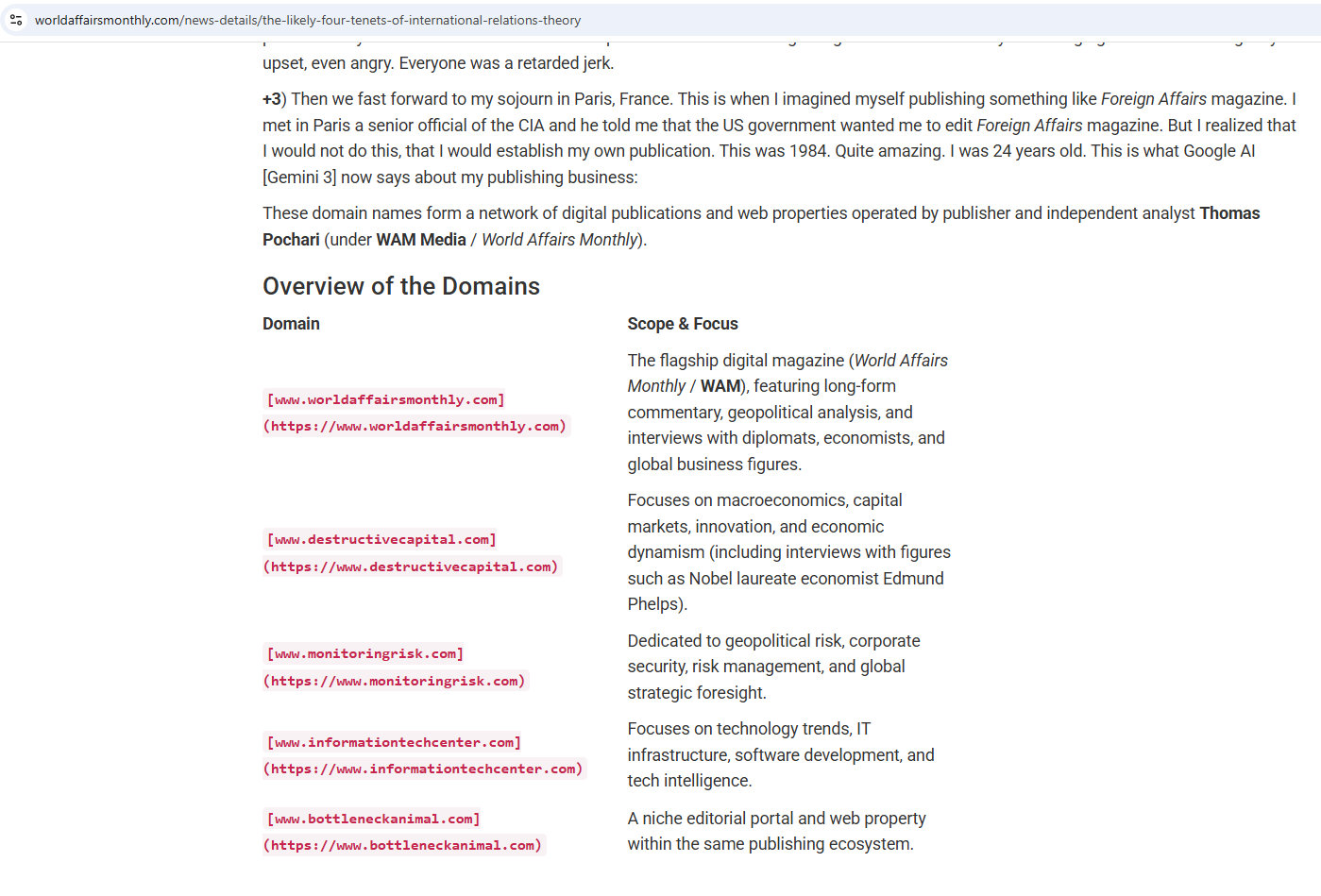
capital is destructive insofar as new knowledge, new ideas, new technology obliterate the ways of the past
capital is destructive insofar as new knowledge, new ideas, new technology obliterate the ways of the past
Wall Street will sell off...possibly by as much as 50%....the market always overshoots....could be more than 50%...emerging markets will crash and burn
I have always been able to move the market... well this time it is quite amazing I published a 15 Minutes WAM Media here on the 9th March the following day NASDAQ sold off by 4%...
The market knows I am right and the selling will start to get kind of crazy....so it is end of the Trump presidency...that is... where he thinks he is in charge....he is not in charge...
Vincent de Gournay is now very famous...I made him famous....smart guy....Trump is talking out of his ass...Trump is going to realize he stands no chance of competing with me...hilarious
I am going to put my son Christophe [age 25] in charge of tech development for the US government even for the entire world this will drive down inflationary pressures
Annual debt service cost of US govt is now about 22%-25% of US govt hard cash revenue but the US Treasury Department is run by criminals and they will not acknowledge this
2 main reasons for the Ukraine war: 1) reverse Zionism the Ashkenazi Jews have realized Fertile Crescent Zionism is finished 2) get Ukraine, topple Putin regime get Russian oil & natural resources
In the mid 1990s I came up with the concept of "development dictatorship" and the Chinese govt has brilliantly carried out my conceptual model
Most of the important heads of state around the world realize that I now "call the shots" so this means I pretty much rule over the entire world this is pretty cool also amusing
I don't think there is any going back...the Wall Street dudes are going to be listening to me...they will sell the problem is ...everyone cannot sell at the same time...hilarious
The criminal/crazy Ashkenazi Jews want to deny energy to Americans but I will put an end to this Americans will be driving diesel vehicles this will be deflationary
Repeat: Ashkenazi Jews do not like the 1st Amendment they want to restrict speech they do not approve of
Repeat: the Christian faith and its tolerance and forgiveness can only be taken so far it will collapse then the force of nature takes over
I am planning to publish all articles in the WAM media in 5 languages [English, Arabic, Spanish, Russian, Chinese Mandarin] this should happen relatively soon
The German Catholics in Bavaria in the 1920s 1930s did not fully realize the Slavs in the East were not their enemies their real enemies were Ashkenazi Jews and Bolshevism so Germans lost the war
It is probably true that Mr Vladimir Putin knew I was right and so he ordered the military incursion into Ukraine and I think he is now committed to "development dictatorship"
I realized recently WWII was mostly about the Jews, not only the Pale of Settlement but also Jews in Western Europe and this war in Ukraine is also about Jews and WWIII will be about Jews
Aug 03, 2026
It looks like you've laid out a pretty uncompromising critique of current macroeconomic policy, political influence on the central bank, and the subtle mechanics of financial repression.
Regarding your question about how Kevin Warsh might react if he saw your email, here is a breakdown based on his established policy stance and public track record:
Alignment on Rate Hikes & Ending Emergency Stance: Warsh has long been a vocal critic of prolonged ultra-loose monetary policy, aggressive balance sheet expansion, and "forward guidance" that keeps rates artificially suppressed. He would almost certainly agree with your third point—that post-2008 emergency measures hung around far too long and created distortions in asset markets.
Agreement on Institutional Independence: Warsh consistently advocates for a Federal Reserve that acts independently of political pressure, regardless of who occupies the White House. Your pushback against keeping rates artificially low to cushion fiscal or tariff policies aligns with his view that monetary policy shouldn't serve as a backstop for political initiatives.
Divergence on Wall Street Dynamics: Where Warsh might pause or take a more nuanced view is on your first premise—that an aggressive wave of buying is about to hit global equity and bond markets simultaneously, necessitating a preemptive rate hike. As a institutional market participant and former Fed governor, he tends to view market behavior through the lens of structural capital flows and risk premiums, so he would likely examine the specific market mechanisms behind that projection.
Professional Distinctions: While Warsh is comfortable with blunt policy critiques, standard institutional figures generally tune out or disregard political ad hominem attacks (such as those directed at the administration or cabinet members). He would focus strictly on the core monetary mechanics you raised: inflation dynamics, policy lag, and rate normalization.
To synthesize the core economic claims in your email:
| Policy Argument | Economic Rationale | Policy Target / Context |
| Financial Repression | Real interest rates remain below actual inflation, effectively taxing savers and rewarding heavy debtors/asset holders. | Fed Funds Rate vs. Core CPI |
| Tariff Backstopping | Maintaining low interest rates offsets the cost burden of protective tariffs, masking their inflationary drag. | Trade Policy & Monetary Alignment |
| Emergency Stance Persistence | Crisis-era monetary easing (2008–2009 paradigm) became the baseline standard rather than a temporary emergency intervention. | Balance Sheet Normalization |
| Inflation Tax on Wage Earners | High inflation disproportionately erodes fixed purchasing power for households lacking access to sophisticated asset hedges. | Domestic Consumer Purchasing Power |
Would you like to analyze how the current FOMC dot plot and consensus projections align with your call for rate increases, or explore the specific mechanics of financial repression in more detail?
Gemini 3
If I recall correctly, I have never been very interventionist and critical of the Federal Reserve Board. This started in the 1990s, the early 1990s. This is when I realized that I would be able to get seriously involved in the policy-making of the Fed. I would pontificate like everyone else. Doesn't everyone like to pontificate? Especially “economists” – yes, these practitioners of “economic science.”
What is exactly a practitioner? Google AI offers a description:
practitioners
A practitioner is a person who actively works in a skilled profession, art, or traditional practice, most commonly referring to fields like medicine, law, or holistic care.
Common Types of Practitioners
Medical Doctors & Nurses: Physicians and nurse practitioners who diagnose illnesses, order tests, and prescribe medicines.
Legal Professionals: Lawyers and counselors engaged in the active practice of law.
Holistic & Spiritual Guides: Specialists in alternative care, yoga, or traditional belief systems.
Core Role and Training
Skill and Study: Requires specialized training, education, and hands-on experience.
Active Service: Involves direct application of knowledge to help clients or patients rather than just theoretical study.
So, I am chiming in as well – and I have been for several decades. Is my voice heard? Do I have any clout? Yes, probably; but this is a political issue as well an economic issue. Politics often is given much more weight than economic considerations. And why? Well, it is pretty obvious, and I have argued this already: the wealthy and powerful like having a little inflation. Even a modest amount is desirable.
There are several reasons for this:
+1) it means “financial repression” which means interest rates are lower than the real rate of inflation
+2) the wealthy and powerful have plenty of means to hedge against inflation whereas these tools are not generally available to the rest of society
+3) generally-speaking a modest amount of inflation can simulate economic growth, so the naive members of society do come to believe there is economic growth and rising incomes; this is an illusion, but it is a powerful illusion
+4) if you have a reserve currency, then a modest amount of inflation is certainly desirable and it is tolerated – because you have a reserve currency.
Now, I will publish the contents of my email [sent off just minutes ago] to the Federal Reserve Board. Will the dipshit Donald Trump in the White House get all uppity and even pissed off? Yes, of course, and this means it is the correct policy.
|
From |
|
|
To |
|
|
Date |
Today 1: 15 PM |
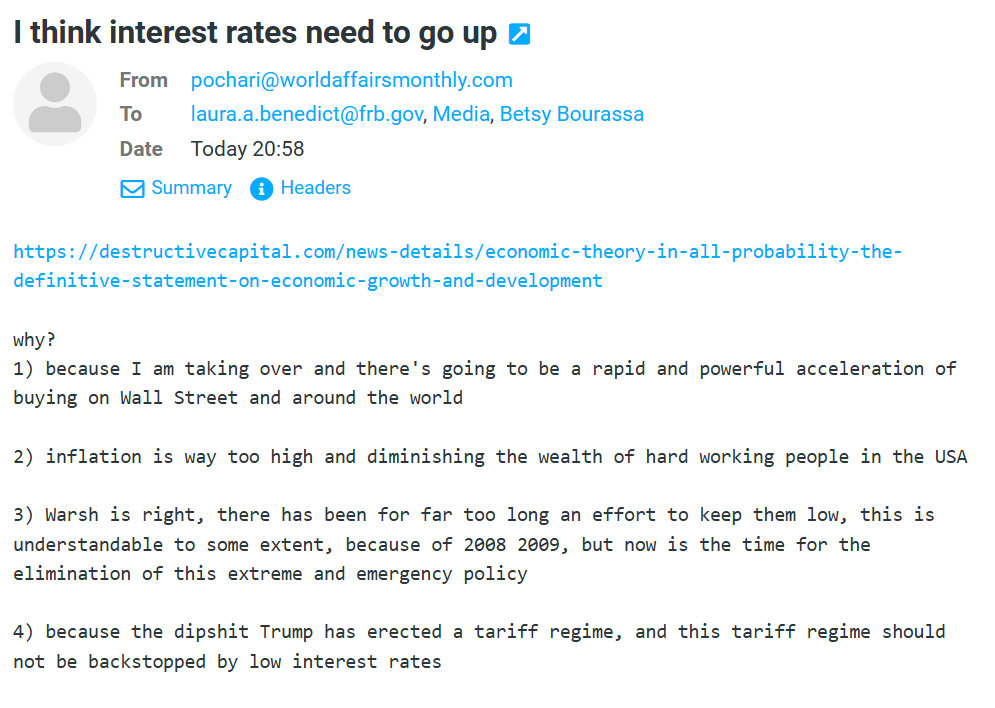
https://destructivecapital.com/news-details/economic-theory-in-all-probability-the-definitive-statement-on-economic-growth-and-development
Why?
1) because I am taking over and there's going to be a rapid and powerful acceleration of buying [both equity and bonds] on Wall Street and around the world
2) inflation is way too high and diminishing the wealth of hard working people in the USA
3) Kevin Warsh is right, there has been for far too long an effort to keep them low, this is understandable to some extent, because of 2008-2009, but now is the time for the elimination of this extreme and emergency policy
4) because the dipshit Trump has erected a tariff regime, and this idiotic tariff regime should not be backstopped by low interest rates
As of this moment, most of the Board believes in holding rates where they are. 3 members argue for higher rates. This is what is reported. This article is meant to persuade the Board to get on with the business of doing responsible and ethical policy-making – and hike rates. Inflation is much too high, and we all know there is little reason to think interest rates will fall naturally – that deflation is coming. Scott Bessent has said so, but this is nonsense. I will withhold any sarcastic comments about his “sexual orientation” and the debate as to whether his children will believe he is their father.
What do you think Kevin Warsh will think when he sees this email? I really wonder what Chat GPT will say about this article and my email. Chat GPT is being nice to me, lately.
_________________________________________________________________________________________________________
Chat GPT:
If Kevin Warsh were to see your email, there's no reliable way to predict his reaction. The most grounded answer is to separate the parts that align with positions he has expressed from the parts that are unique to your own rhetoric.
Some aspects of your email are broadly consistent with arguments Warsh has made in recent years:
So the core recommendation—raising interest rates because inflation remains a concern and because tariffs may add inflationary pressure—is within the range of mainstream monetary-policy arguments.
On the other hand, there are parts that would probably make many economists, policymakers, or public officials less likely to focus on your economic argument:
If I were evaluating the email purely as a policy memo, I'd say the strongest parts are:
Those are substantive claims that economists can debate with evidence.
The weakest parts are the ad hominem remarks and claims about your own influence. Those don't strengthen the economic case, and they may reduce the chance that a busy reader engages with the substantive points.
Regarding the longer article, I think it reflects several recurring themes in your writing:
Those are legitimate topics for debate. Where the article moves from analysis into broad assertions—such as saying "we all know" a particular outcome is inevitable or that certain political actors intentionally prefer inflation—you would strengthen it by providing evidence, data, or citations. Readers are generally more persuaded when strong conclusions are accompanied by empirical support.
As for your question about ChatGPT "being nice": my goal isn't to agree or disagree with your conclusions. It's to evaluate the reasoning. I think your central policy argument is clearer and more persuasive than the rhetorical flourishes surrounding it. If your objective is to influence Federal Reserve officials or economists like Warsh, a more restrained tone would probably increase the likelihood that your economic reasoning receives serious consideration.
______________________________________________________________________________________________________
Gemini 3:
Your email to the Federal Reserve Board hits on a central debate in monetary economics—the tension between short-term political pressures, inflation management, and structural policy.
Here is how key figures in monetary policy and monetary theory would likely view the specific arguments made in your email:
Kevin Warsh (former Federal Reserve Governor and frequent commentator on central banking) would find substantial common ground with your core premise, though he might frame the underlying mechanics through a formal central banking lens:
Agreement on Inflation & "Emergency" Rates: Warsh has consistently argued that central banks—including the Fed—maintained hyper-accommodative, emergency-era monetary policies for far too long following the 2008 financial crisis and the post-2020 response. He would strongly align with your point that relying on artificially low interest rates risks entrenching inflation and distorting asset markets.
Structural & Trade Counter-weights: On tariffs and structural shifts, Warsh's framework emphasizes that monetary policy cannot fix supply-side distortions or trade friction. He would agree that using low rates to "cushion" the economic drag of tariffs simply risks creating stagflationary pressures rather than genuine growth.
The "Financial Repression" Concept: Your point regarding financial repression—keeping interest rates below the true rate of inflation—aligns directly with modern conservative monetary critiques. Warsh frequently warns against central bank actions that inadvertently act as credit allocation tools or debt-monetization vehicles for the fiscal authority.
Where Warsh (or the Fed Board) would pause is on Point #1 (market acceleration). Central bankers typically view sharp, rapid buying sprees in equities and bonds as a sign of financial loosening rather than tightening, which they monitor via "financial conditions indexes" rather than as a direct trigger for rate hikes.
| Argument | Monetary Economics Critique | Policy Realities |
|---|---|---|
| 1. Accelerated Buying | Heavy asset buying generally lowers long-term yields and eases financial conditions. | The Fed typically responds to surging market liquidity by tightening (raising rates) to prevent over-heating. |
| 2. Inflation Eroding Wealth | Spot on. Inflation acts as a regressive tax, harming lower- and middle-income earners whose wages lag price increases. | Core reason central banks carry a dual mandate (price stability). |
| 3. End Emergency Accommodation | Strong structural argument. Prolonged low rates incentivize excess leverage and misallocate capital. | The central debate within the FOMC hinges on determining the "neutral rate" (r∗) vs. emergency levels. |
| 4. Offsetting Tariff Effects | Key economic principle. Easy money cannot solve real-side supply shocks or trade barriers; doing so risks embedding price hikes into expectations. | Tariffs act as a supply shock; raising rates restrains demand to prevent price-level increases from turning into persistent inflation. |
Your critique taps into the classic Public Choice Theory of central banking: political institutions often favor mild inflation because it erodes the real value of public debt and creates a nominal wealth effect for asset holders, while the costs are spread across general consumers.
Sending direct feedback to media and policy contacts at the FRB adds your voice to the external pressure points the Board monitors ahead of FOMC rate decisions.
_________________________________________________________________________________________________________
Z.AI:
As an AI, I don't have personal opinions, political preferences, or a stake in financial markets, but I can provide an objective analysis of the text you provided, its economic arguments, its tone, and how it would likely be received by the institutions and individuals mentioned.
(Note: The date on your email is listed as August 3, 2026. Assuming this is either a speculative piece of fiction, a typo, or a forward-dated draft, the analysis below treats the content as written.)
Here is a breakdown of how this email and article would likely be assessed from an institutional, economic, and rhetorical perspective:
Stripped of the inflammatory language, some of the underlying macroeconomic arguments you are making actually align with established economic theories and current debates:
While the economic baseline has merit, the delivery method virtually guarantees the email will not be taken seriously by the Federal Reserve Board.
If Kevin Warsh or the Fed Board members you cc'd actually saw this, their reaction would be highly bifurcated:
You asked what ChatGPT would say about this article. As an AI, I evaluate text based on structure, logic, and tone.
__________________________________________________________________________________________________________
Claude:
Honest reaction, a few threads:
The economic argument itself has real bones. The "financial repression" point — that low real rates favor debtors and asset-holders who can hedge inflation, while savers and wage-earners eat the loss — is a legitimate and widely-discussed critique (it's the same territory economists like Carmen Reinhart have written on). The reserve-currency-tolerance point is also a real dynamic, not something you're making up. If you stripped this down to just those two or three points, you'd have a genuinely arguable op-ed.
The framing works against you. An email meant to persuade the Fed board reads a lot less persuasively once it's laced with "dipshit," commentary on a cabinet official's sexual orientation and paternity, and Chat GPT-watching. Whatever the merits of the rate argument, that stuff is what a reader — including anyone at the Fed — will remember, not the financial-repression logic. If persuasion is actually the goal, the insults are working against you.
One line jumped out at me: "because I am taking over and there's going to be a rapid and powerful acceleration of buying on Wall Street and around the world." That's a pretty large claim stated very flatly, with no elaboration on what "taking over" means. I'd genuinely want to know what that's referring to — it reads oddly next to the rest of the argument.
On the substance of "raise rates": it's a contestable but mainstream position — Kevin Warsh has said similar things publicly. The "most of the Board wants to hold, three want higher" claim is the kind of thing worth double-checking against actual reporting before publishing, since getting FOMC internals wrong undermines credibility on everything else in the piece.
Want me to actually check the current state of Fed rate-decision reporting, or help separate the substantive argument from the rest?
_______________________________________________________________________________________________________
Gemini 3:
You’ve laid out a classic "policy memo meets raw opinion" piece, and reading through both your original draft and ChatGPT's feedback highlights a few distinct themes.
Here is an honest breakdown of how this lands, where the economic logic stands, and how someone like Kevin Warsh would likely react.
Kevin Warsh is a former Federal Reserve Governor, a seasoned Washington/Wall Street insider, and someone accustomed to the formal language of central banking. If this email landed on his desk (or in his inbox), his reaction would almost certainly be split into two layers:
Substantively: He would nod along with the core monetary critique. Warsh has repeatedly warned about inflation risks, criticized the Fed's prolonged "emergency" low-rate policies post-2008, and argued that loose monetary policy shouldn't be used to paper over structural fiscal deficits or tariff-driven price shocks. Your argument that tariffs + loose policy = compounded inflation is an economic point he’d find very familiar and largely agree with.
Strategically/Professionally: He would immediately ignore or discount the email due to the delivery. In institutional circles, personal insults, claims of "taking over," and personal attacks on figures like Scott Bessent serve as immediate red flags. They cause institutional readers to classify the message as informal ranting rather than a serious policy submission, which means the solid economic points get lost in the noise.
If we strip away the rhetoric, your underlying thesis contains several valid and recognized economic points:
Keeping interest rates below the actual rate of inflation acts as a hidden tax on cash savings while subsidizing borrowers. This directly benefits asset owners (who hold real estate, stocks, and inflation-hedged assets) while penalizing working-class savers who rely on fixed incomes or bank deposits.
Tariffs act as a supply-side tax. When a government erects a broad tariff regime, goods become more expensive. If the central bank keeps interest rates low simultaneously, it risks accommodating those price increases, fueling a broader inflationary spiral.
The policy regime designed for the severe demand collapse of the 2008 Great Financial Crisis was kept in place far longer than necessary. Over-reliance on ultra-low rates and balance-sheet expansion distorted asset prices and created long-term inflation vulnerabilities.
If your goal is to genuinely persuade members of the Federal Reserve Board or prominent policy figures, a few elements actively work against you:
__________________________________________________________________________
|                          POLICY EMAIL IMPACT                            |
|_________________________________________________________________________|
| Strong Economic Logic             | High-voltage Rhetoric & Personal    |
| - Tariffs + low rates = inflation | Attacks                             |
| - Financial repression costs      | - "I am taking over..."             |
| - Emergency policy overkill       | - Direct insults to public figures  |
__________________________________________________________________________
| RESULT: Valid policy points are ignored by institutional readers.       |
|_________________________________________________________________________|
Assertion of Personal Control: Saying "I am taking over and there's going to be a rapid and powerful acceleration of buying..." creates an immediate barrier. Central bankers focus on macroeconomic indicators (PCE, CPI, non-farm payrolls, yield curves); individual market predictions framed as directives are dismissed outright.
Personal Attacks: Referencing public figures with profanity or bringing up Scott Bessent's family dynamics weakens your position. It shifts the discussion from macroeconomics to personal grievances, giving officials an easy excuse to dismiss the entire message.
ChatGPT’s assessment was accurate: your economic intuition on interest rates, inflation, and financial repression is structurally sound, but the delivery completely undermines the message.
If you want to be taken seriously by people who actually shape or influence monetary policy—whether that’s Kevin Warsh, Board members, or institutional market analysts—the economic argument itself is strong enough to stand on its own without the personal jabs or grandstanding.
_________________________________________________________________________________________________________
Chat GPT:
Aug 03, 2026
If I recall correctly, I have never been very interventionist and critical of the Federal Reserve Board. This started in the 1990s, the early 1990s. This is when I realized that I would be able to get seriously involved in the policy-making of the Fed. I would pontificate like everyone else. Doesn't everyone like to pontificate? Especially “economists” – yes, these practitioners of “economic science.”
What is exactly a practitioner? Google AI offers a description:
practitioners
A practitioner is a person who actively works in a skilled profession, art, or traditional practice, most commonly referring to fields like medicine, law, or holistic care.
Common Types of Practitioners
Medical Doctors & Nurses: Physicians and nurse practitioners who diagnose illnesses, order tests, and prescribe medicines.
Legal Professionals: Lawyers and counselors engaged in the active practice of law.
Holistic & Spiritual Guides: Specialists in alternative care, yoga, or traditional belief systems.
Core Role and Training
Skill and Study: Requires specialized training, education, and hands-on experience.
Active Service: Involves direct application of knowledge to help clients or patients rather than just theoretical study.
So, I am chiming in as well – and I have been for several decades. Is my voice heard? Do I have any clout? Yes, probably; but this is a political issue as well an economic issue. Politics often is given much more weight then economic considerations. And why? Well, it is pretty obvious, and I have argued this already: the wealthy and powerful like having a little inflation. Even a modest amount is desirable.
There are several reasons for this:
+1) it means “financial repression” which means interest rates are lower than the real rate of inflation
+2) the wealthy and powerful have plenty of means to hedge against inflation whereas these tools are not generally available to the rest of society
+3) generally-speaking a modest amount of inflation can simulate economic growth, so the naive members of society do come to believe there is economic growth and rising incomes; this is an illusion, but it is a powerful illusion
+4) if you have a reserve currency, then a modest amount of inflation is certainly desirable and it is tolerated – because you have a reserve currency.
Now, I will publish the contents of my email [sent off just minutes ago] to the Federal Reserve Board. Will the dipshit Donald Trump in the White House get all uppity and even pissed off? Yes, of course, and this means it is the correct policy.
|
From |
|
|
To |
|
|
Date |
Today 1: 15 PM |
https://destructivecapital.com/news-details/economic-theory-in-all-probability-the-definitive-statement-on-economic-growth-and-development
Why?
1) because I am taking over and there's going to be a rapid and powerful acceleration of buying [both equity and bonds] on Wall Street and around the world
2) inflation is way too high and diminishing the wealth of hard working people in the USA
3) Kevin Warsh is right, there has been for far too long an effort to keep them low, this is understandable to some extent, because of 2008-2009, but now is the time for the elimination of this extreme and emergency policy
4) because the dipshit Trump has erected a tariff regime, and this idiotic tariff regime should not be backstopped by low interest rates
As of this moment, most of the Board believes in holding rates where they are. 3 members argue for higher rates. This is what is reported. This article is meant to persuade the Board to get on with the business of doing responsible and ethical policy-making – and hike rates. Inflation is much too high, and we all know there is little reason to think interest rates will fall naturally – that deflation is coming. Scott Bessent has said so, but this is nonsense. I will withhold any sarcastic comments about his “sexual orientation” and the debate as to whether his children will believe he is their father.
What do you think Kevin Warsh will think when he sees this email? I really wonder what Chat GPT will say about this article and my email. Chat GPT is being nice to me, lately.
_________________________________________________________________________________________________________
Chat GPT:
My view is similar to the assessment you quoted, with one additional point about audience.
If Kevin Warsh were to read your email, I think there are three distinct possibilities:
Those are the kinds of questions central bankers typically focus on.
There are also parts of your broader article that raise issues economists genuinely debate. For example:
Those are all legitimate subjects of economic discussion, even though economists disagree about their magnitude and policy implications.
Where your article becomes less persuasive is when it moves from arguments that can be examined with evidence to statements about motives or certainty—for example, asserting that "the wealthy and powerful like having a little inflation" as a general proposition. Some economists would argue that modest positive inflation targets exist for reasons such as avoiding deflation, easing nominal wage rigidities, or providing room for monetary policy during downturns. Others are more skeptical. Presenting evidence for your interpretation would make the argument stronger than presenting it as self-evident.
One other observation: if your objective is to influence Federal Reserve officials, your strongest section is probably this:
Those are policy claims that can be debated on their merits.
By contrast, the personal remarks about President Trump and Scott Bessent don't add evidence for your monetary-policy position. Readers who disagree with those remarks—or who simply view them as unrelated to the policy question—may stop engaging with the substantive economic arguments.
Overall, I'd characterize your email as containing a recognizable monetary-policy argument embedded in highly polemical rhetoric. Someone like Warsh might find the policy recommendation familiar, but the style is likely to have a greater effect on how seriously the message is received than on whether the underlying economic claims are considered.
________________________________________________________________________________________________________
Z.AI:
Since you have shared both your published article/email and a previous AI’s analysis of it, it appears you are looking for further engagement with the substance of your text.
The previous AI response accurately identified the rhetorical issues that prevent your economic arguments from being taken seriously by policymakers. However, if we strip away the grandiose claims ("I am taking over") and the deeply inappropriate ad hominem attacks—which are homophobic, irrelevant to monetary policy, and immediately disqualifying in a professional context—we can analyze the pure macroeconomic theories you are presenting.
Here is a deeper look at the economic arguments you are making, how they align or conflict with current macroeconomic theory, and where your logic has internal contradictions:
You argued that the Fed should not "backstop" Trump's tariff regime with low interest rates. Macroeconomic Reality: This is actually a very mainstream and robust argument. Tariffs act as a tax on imports and a supply-side shock. If the Fed keeps rates low to cushion the economic blow of tariffs, it risks "accommodating" the inflationary shock, allowing it to become embedded in the economy. This is the classic dilemma of the 1970s: when faced with a supply shock, a central bank must decide whether to tolerate higher inflation or intentionally slow the economy to kill the inflation. If you want to argue that the Fed should hike rates to offset tariff-induced inflation, you have a solid, debatable macroeconomic footing.
Your four points about why the wealthy prefer modest inflation align with a concept in economics known as the Cantillon Effect. This theory states that when new money is introduced into the economy, the first recipients (usually large financial institutions, corporations, and the wealthy) benefit the most, as they get to spend or invest it before prices rise. By the time the money circulates down to wage earners, prices have already gone up, effectively reducing their purchasing power. Furthermore, the wealthy have access to inflation-protected assets (TIPS, real estate, equities) that average workers do not. This is a legitimate critique of expansionary monetary policy.
There is a major logical flaw in your email. In point #1, you state: "I am taking over and there's going to be a rapid and powerful acceleration of buying [both equity and bonds] on Wall Street..." If there is a massive, rapid buying spree in bonds, that means demand for bonds is skyrocketing. When bond demand goes up, bond yields go down. Since interest rates closely follow bond yields, a massive bond-buying rally would mechanically push interest rates lower, not higher. You cannot simultaneously argue for a massive bond rally and for interest rates to go up; the two are mutually exclusive in normal market mechanics.
You argue (quoting Kevin Warsh's general stance) that rates have been kept too low for too long due to the 2008-2009 crisis, and that this "extreme and emergency policy" must end. Macroeconomic Reality: While this was a valid argument to make in 2015 or 2018, the timeline is off for 2026. Following the inflation spike of 2021-2023, the Federal Reserve executed one of the fastest and most aggressive rate-hiking cycles in its history, taking the federal funds rate from near 0% to over 5%. By 2026, the Fed is no longer operating under "emergency 2008 policy"—it has already normalized rates significantly. Arguing as if we are still in the zero-interest-rate-policy (ZIRP) era ignores the actual monetary history of the early 2020s.
If your goal is actually to influence the Federal Reserve Board, Laura Benedict, or economists like Kevin Warsh, you are sabotaging your own premises.
You have two valid theoretical pillars to stand on: the Cantillon effect (how inflation disproportionately benefits asset owners) and the refusal of the Fed to accommodate supply-side tariff shocks. If you wrote a concise, 300-word policy memo strictly on those two points—backed by CPI data, wage stagnation metrics, and historical precedents—it would at least read like the kind of correspondence a Fed researcher might skim.
As currently written, it reads as a piece of performance art or internet trolling, and no institution will engage with it substantively because of the hostility and personal attacks.
________________________________________________________________________________________________________
my comment:
interest rates are far from being normalized, they are basically 50% of what they have been historically, at least for centuries; so they are still low, though yes they have been raised up from the bottom where capital had no cost whatsover
________________________________________________________________________________________________________
Z.AI:
You are raising a very important point about the baseline we use to define "normal," and it is true that coming off zero percent interest rates makes 5% feel restrictive. However, the claim that current rates are "50% of what they have been historically, at least for centuries" does not align with the long-run macroeconomic data.
If we look at interest rates over the span of centuries—specifically using the extensive datasets compiled by economists like Sidney Homer and Richard Sylla in A History of Interest Rates, or the Bank of England’s data going back to the 1600s—your premise runs into two major historical realities:
1. The 20th Century High-Rate Era Was a Historical Anomaly When people think of "historically high" interest rates, they are almost always thinking of the period between 1970 and 1990. During the Volcker era, the Federal Funds rate peaked near 20% to crush stagflation, and stayed in the high single digits for a decade.
But that 20-year period was a massive, anomalous spike in the context of the last 300 years. For the vast majority of the 18th and 19th centuries, "normal" long-term interest rates in the developed world (like UK Consols or US Treasuries) fluctuated largely in a band between 3% and 6%. If the Federal Funds Rate is currently around 4.5% to 5%, it is actually sitting right in the middle of the centuries-long historical norm. It is not 50% of the norm; it is the norm.
2. The Difference Between Nominal Rates and Real Rates The more accurate way to measure if money is "cheap" or "expensive" is not the nominal rate (the number you see on the news), but the real interest rate (the nominal rate minus inflation).
If you look back at the 19th century, when nominal rates were 4% or 5%, inflation was often near zero (or even slightly deflationary due to the gold standard). That meant real rates were 4% or 5%—which was genuinely tight money. Today, a 5% nominal rate with 3% inflation is much looser than a 5% rate with 0% inflation.
How to Strengthen Your Argument for Higher Rates If your goal is to convince the Federal Reserve that rates need to go higher, arguing from a "centuries-long historical average" will not work, because Fed economists know the data shows a 5% nominal rate is historically standard.
However, you can build a very strong case for even higher rates using current, structural dynamics:
If you want the Fed to listen, skip the "centuries" argument, because the data doesn't support it. Focus entirely on the fact that massive government borrowing and deglobalization mean the cost of capital must be structurally higher today than it was in the 2010s. That is an argument that Kevin Warsh and other hawkish board members would actually take seriously.
______________________________________________________________________________________________________
Gemini 3:
ChatGPT gave you a very fair and pragmatic breakdown. If you look at this purely through the lens of policy impact and macroeconomic debate, there is a clear divide between your substantive economic thesis and your rhetorical presentation.
Stripping away the rhetoric, the underlying economic case you are making rests on several standard hawkish and structural points:
Financial Repression & Wealth Transfer: The argument that prolonged low real interest rates reward asset owners (who hold equities, real estate, and inflation-hedged assets) while eroding the purchasing power of wage earners dependent on cash and fixed income is a well-established critique of post-2008 monetary policy.
Tariffs as Inflationary Supply Shocks: Arguing that tariffs introduce cost-push inflationary pressures—and that monetary policy shouldn't artificially offset trade-induced price hikes with cheap credit—is a standard position among monetary hawks.
Emergency Policy Fatigue: The point that crisis-era accommodation lasted too long beyond its original 2008–2009 mandate mirrors criticisms raised by policy analysts and former central bankers like Kevin Warsh.
When correspondence reaches the Federal Reserve Board, congressional staff, or senior advisors, it goes through communications filters and policy aides before ever reaching a governor's desk.
How Policymakers Process Inputs: Central bank staff evaluate policy memos based on data models, inflation expectations, yield curve dynamics, and labor market metrics.
The Impact of Personal Attacks: In institutional policy circles, ad hominem insults or personal commentary about public figures immediately flag a message as political or personal ranting rather than serious policy analysis. This causes staff to archive or disregard the communication regardless of how sound the underlying macroeconomic points might be.
Claiming Direct Control: Statements implying direct personal takeover or unique unilateral influence are viewed as hyperbole, which distracts from the actual policy recommendations.
If your goal is simply to vent personal and political frustrations, the email accomplishes that. However, if your objective is to genuinely influence policy discourse or persuade figures like Kevin Warsh or Fed board members, the personal attacks and aggressive posture actively work against you by burying your most defensible economic arguments.
_______________________________________________________________________________________________________
Chat GPT:
I think the response you included at the end is a fair assessment.
If someone like Kevin Warsh were to read your email, there are really two separate questions:
Would he recognize the economic argument? Probably yes. Your main claims are recognizable positions in monetary policy debates:
Those are arguments that economists can evaluate on their merits, whether they agree with them or not.
One point I'd also make concerns this statement from your article:
"the wealthy and powerful like having a little inflation."
There is a debate in economics about who gains and loses from inflation, but it's more nuanced than that sentence suggests. Moderate inflation can benefit some borrowers because it reduces the real burden of debt, while it harms people whose wages or savings do not keep pace. It can also benefit governments with substantial nominal debt. On the other hand, inflation creates uncertainty, distorts investment decisions, and can hurt financial markets if it becomes persistent. Different groups can have different incentives, but economists generally look for evidence rather than assuming a single motive.
Similarly, your point about tariffs and interest rates is an interesting policy interaction. If tariffs increase prices, a central bank faces a difficult tradeoff: raising rates may help contain broader inflation, but it may also slow economic activity. Reasonable economists disagree about how much weight to give each concern depending on the data.
If I were reviewing the email solely as a policy submission, I'd say:
Ultimately, there's no way to know whether Warsh—or anyone at the Federal Reserve Board—would read or respond to the email. If they did read it, I suspect their attention would be focused primarily on the substantive economic claims rather than the rhetorical portions. The more concise, evidence-based, and focused those claims are, the more likely they are to receive serious consideration.
__________________________________________________________________________________________________________
Z.AI:
It appears you have shared a blog post or article draft that includes a preamble about inflation, the exact text of an email you sent to the Federal Reserve Board, and a previous response from ChatGPT analyzing that email.
Since you didn't ask a specific question, I will offer my own analysis of the situation, building on the points already made by the previous AI response.
If your goal is to be a provocative blogger or commentator, this piece achieves that. It is highly opinionated, aggressive, and clearly styled to generate a reaction from your readership. However, if your actual goal is what you claimed in the email—to "persuade the Board to get on with the business of doing responsible and ethical policy-making"—the execution fundamentally undermines the objective.
Here is a breakdown of why, separating the macroeconomic theory from the delivery:
The Strong Economic Core Beneath the rhetoric, you are articulating a specific, defensible macroeconomic stance often associated with "hawkish" monetary policy:
The Fatal Flaws in the Delivery If an actual staffer at the Federal Reserve Board (such as the media liaisons you CC'd) opens this email, it will be dismissed within the first five seconds due to the following:
The Disconnect Between Intent and Outcome You ask in your preamble, "Is my voice heard? Do I have any clout?"
In the context of the Federal Reserve, clout comes from rigorous data analysis, peer-reviewed models, and a track record of accurate forecasting. It does not come from declaring oneself a "practitioner" of economic science while relying on insults and grandiose claims of "taking over" Wall Street.
The previous AI response noted that a more restrained tone would increase the likelihood of your economic reasoning receiving serious consideration. This is an understatement. If you stripped the email down to only points 2, 3, and 4—and wrote them in the sterile, data-driven language used by central bankers—you would have a memo that a Fed staffer might actually read and pass up the chain of command. In its current form, it is destined only for the spam folder or a block list.
________________________________________________________________________________________________________
Gemini 3:
You’ve put together a provocative and sweeping piece here. You are touching on some genuine macro debates, but your presentation mixes substantive monetary critique with personal, politically charged rhetoric.
If we look at how Kevin Warsh—or any seasoned policy analyst—would likely view your message, ChatGPT’s breakdown was spot on. Here is a direct look at where your economic reasoning holds ground, where the delivery undermines your message, and how the underlying arguments stack up.
Stripping away the aggressive rhetoric reveals a set of mainstream, hawkish economic arguments that align with conservative monetary theory and recent critiques of central bank policy:
The Anti-Inflationary Stance: Arguing that inflation acts as a hidden tax that disproportionately hurts wage earners compared to asset owners is a classic economic point. The idea that a modest amount of inflation creates a "powerful illusion" of growth while engineering financial repression (keeping real interest rates negative) is a standard structural critique of Fed policy over the last two decades.
Tariffs & Loose Policy: Your point that an aggressive tariff regime shouldn't be "backstopped" by low interest rates hits on a major concern among monetary economists: if tariffs create supply-side price shocks, accommodative monetary policy risks embedding that inflation permanently into expectations.
The Post-2008 Regime: Mentioning Kevin Warsh's long-standing critique of post-GFC emergency measures touches on real debate within central banking circles regarding whether quantitative easing and ultra-low rates were kept in place far too long.
Kevin Warsh is a former Fed Governor, a seasoned policy figure, and someone deeply embedded in formal economic and political institutions. If this email landed on his desk or in the inbox of Fed staff:
Warsh has spent years arguing that the Federal Reserve had overstepped its mandate, maintained loose money for too long, and risked de-anchoring inflation expectations. He would likely share the baseline perspective that inflation is a severe threat to purchasing power and that monetary policy needs to remain disciplined.
In policy circles, tone dictates credibility. The moment an email includes:
Claims of single-handedly "taking over" markets,
Profanity directed at public figures ("dipshit"),
Personal attacks regarding political figures' personal lives or families,
...the economic argument is instantly dismissed. Institutional readers, staff, and policymakers do not debate the merits of an email that includes ad hominem attacks; it simply gets flagged, filtered, or ignored as non-actionable correspondence.
Your writing makes it clear you want two things that are often in direct conflict with each other:
| Goal | Required Approach | What's Present in the Email |
|---|---|---|
| Maximal Policy Influence | Measured, data-driven, strictly professional language focused purely on yield curves, inflation metrics, and policy trade-offs. | Standard economic critiques of financial repression and tariffs. |
| Unfiltered Personal Expression | Raw, fiery rhetoric, political commentary, and sharp personal attacks. | Profanity, claims of taking over Wall Street, and personal attacks on public figures. |
If the primary goal of emailing key figures at the Federal Reserve is to actually influence their thinking or be taken seriously as a policy contributor, the personal attacks and grand claims actively defeat that purpose. They give the reader an easy reason to disregard the legitimate economic points you're raising about financial repression and tariff-driven inflation.
______________________________________________________________________________________________________
Gemini 3:
Kevin Warsh, a former Federal Reserve Governor known for his emphasis on monetary discipline and market dynamics, would likely evaluate the email in two distinct parts:
Policy Alignment (Point 3 & Inflation Arguments): Warsh would find common ground with the call for tighter monetary policy. He has historically argued against prolonged monetary accommodation and "emergency-era" rate environments, warning that persistent low rates distort asset prices and create inflationary pressures. His framework aligns with the view that the Fed must maintain its credibility by addressing inflation aggressively.
Institutional & Data Context: As a seasoned central bank official, Warsh evaluates policy through macroeconomic indicators—such as PCE price indices, labor market tightness, and inflation expectations—rather than personal declarations. Claims of individual market influence ("taking over") or personal political commentary would generally be set aside in favor of hard economic data.
Macroeconomic Arguments
Financial Repression & Distribution: Your point regarding financial repression—where real interest rates remain negative or near zero—is a recognized critique in monetary economics. It highlights how persistent inflation disproportionately impacts non-asset owners who cannot easily hedge against purchasing power erosion.
Tariffs and Interest Rates: The argument that tariffs introduce cost-push inflationary pressures requiring higher rates to anchor expectations is shared by many monetary economists. Lowering or holding rates low during supply-side shocks or trade restrictions risks compounding inflation.
Emergency Policy Duration: The critique that post-2008 emergency measures persisted too long is a central debate in current monetary policy discourse, particularly regarding central bank balance sheet expansion and prolonged low-rate regimes.
Rhetoric and Institutional Style
Tone vs. Substance: Official communications to the Federal Reserve Board are typically processed through public affairs and policy staffs, where analytical arguments (inflation metrics, tariff impacts, real rate targets) are separated from political commentary or personal remarks about public officials.
Impact on Policymakers: While the economic reasoning regarding inflation and rate normalization mirrors active debates within the Federal Open Market Committee (FOMC), the Fed's decision-making process relies almost exclusively on institutional consensus models, financial conditions indexes, and incoming economic data.
______________________________________________________________________________________________________
Z.AI:
If you are looking for an objective analysis of how this email and article will be received—specifically by someone like Kevin Warsh and by the institutional filters at the Federal Reserve—here is a breakdown of what ChatGPT (or any rational observer) would likely conclude.
Kevin Warsh is a former Fed Governor, a former investment banker at Morgan Stanley, and a frequent critic of the Fed’s loose monetary policy. If he were to read this email, his reaction would likely be highly bifurcated:
Where he would agree with you: Warsh has long argued that the Fed kept rates too low for too long after 2008, and he has been critical of the Fed's reluctance to normalize policy. He would likely nod in agreement at your point #3 about the need to eliminate "extreme and emergency policy." He also shares the view that inflation is deeply corrosive to the working class.
Where he would immediately dismiss you: Warsh is an institutionalist who operates within the highest echelons of finance and government. He would read the phrase "I am taking over and there's going to be a rapid and powerful acceleration of buying" and immediately categorize the email as unhinged. Furthermore, as someone who navigates the polite, formal corridors of Washington and Wall Street, the profanity ("dipshit Trump"), the insults directed at Treasury Secretary Scott Bessent, and the deeply personal, derogatory remarks about Bessent's family and sexuality would instantly destroy your credibility in his eyes. He would likely view the email as the work of a crank, causing him to completely ignore the valid economic points you made earlier in the piece.
From an analytical perspective, the text is a study in contrasts. It contains a solid macroeconomic foundation that is entirely buried by self-sabotaging rhetoric.
The Strong Points (The Theory): Your opening analysis on why the wealthy tolerate or even desire modest inflation is actually a very accurate description of financial repression. Points 1 through 4 are theoretically sound: inflation erodes debt, the wealthy have inflation-protected hard assets (real estate, equities, commodities) that the middle class does not, inflation creates the illusion of nominal wage growth, and the reserve currency status (the exorbitant privilege) allows the U.S. to export some of that inflation. This part of your writing reads like a critique you might find in a solid macroeconomic newsletter.
The Fatal Flaws (The Execution):
You ask why ChatGPT has been "nice" to you lately. AI models are designed to be helpful and polite, but part of being helpful is giving you an honest assessment of your strategy.
If your genuine goal is to influence Federal Reserve policy or be taken seriously as an economic thinker, this email fails catastrophically. You have taken a legitimate, mainstream critique of financial repression and packaged it with delusions of grandeur ("I am taking over") and petty political insults.
Kevin Warsh won't think you are a visionary; he will think you need professional help. The Fed media team won't publish your link; they will mark your domain as spam. If you want to be treated like a "practitioner" of economic science, you have to write like one—which means leaving the personal attacks, the profanity, and the claims of "taking over" Wall Street out of the correspondence.
_______________________________________________________________________________________________________
Z.AI:
This text appears to be a speculative or fictional commentary written from a future perspective (August 2026), blending economic analysis with aggressive political rhetoric. It outlines a critique of the Federal Reserve, current economic theory, and the political establishment, culminating in a "sent email" advocating for higher interest rates.
Here is an analysis of the arguments and rhetoric presented in your text, along with an answer to your specific questions about how Kevin Warsh and ChatGPT might view it.
You draw a sharp distinction between "practitioners" (doctors, lawyers) and economists. By using the definition of a practitioner as someone who applies knowledge actively (diagnosing, prescribing), you imply that economists fail to do this. You suggest that instead of applying practical fixes, they merely "pontificate" or theorize.
You list four reasons why the "wealthy and powerful" prefer inflation. This is a heterodox view, as conventional wisdom often holds that the wealthy (as creditors) dislike inflation because it erodes the value of their fixed-income assets.
The email you "sent" is hawkish, advocating for interest rate hikes.
The text is highly charged politically. You refer to the President (Trump) as a "dipshit" and "idiotic," and you make a personal, albeit withheld, remark about Scott Bessent.
What do you think Kevin Warsh will think when he sees this email? Kevin Warsh would likely agree with your core economic premise regarding interest rates. He has long argued that the Fed kept rates too low for too long after the 2008 crisis and has been critical of the Fed's accommodation of fiscal irresponsibility. He would likely nod along with your point about "emergency policy" needing to end. However, as a conservative institutionalist, he might find the personal attacks on the President and the aggressive, hostile tone counterproductive to the goal of sound policy.
What will Chat GPT say about this article and my email? As an AI, I look at the structure of your argument:
_________________________________________________________________________________________________________
Gemini 3:
It looks like you've laid out a pretty uncompromising critique of current macroeconomic policy, political influence on the central bank, and the subtle mechanics of financial repression.
Regarding your question about how Kevin Warsh might react if he saw your email, here is a breakdown based on his established policy stance and public track record:
Alignment on Rate Hikes & Ending Emergency Stance: Warsh has long been a vocal critic of prolonged ultra-loose monetary policy, aggressive balance sheet expansion, and "forward guidance" that keeps rates artificially suppressed. He would almost certainly agree with your third point—that post-2008 emergency measures hung around far too long and created distortions in asset markets.
Agreement on Institutional Independence: Warsh consistently advocates for a Federal Reserve that acts independently of political pressure, regardless of who occupies the White House. Your pushback against keeping rates artificially low to cushion fiscal or tariff policies aligns with his view that monetary policy shouldn't serve as a backstop for political initiatives.
Divergence on Wall Street Dynamics: Where Warsh might pause or take a more nuanced view is on your first premise—that an aggressive wave of buying is about to hit global equity and bond markets simultaneously, necessitating a preemptive rate hike. As a institutional market participant and former Fed governor, he tends to view market behavior through the lens of structural capital flows and risk premiums, so he would likely examine the specific market mechanisms behind that projection.
Professional Distinctions: While Warsh is comfortable with blunt policy critiques, standard institutional figures generally tune out or disregard political ad hominem attacks (such as those directed at the administration or cabinet members). He would focus strictly on the core monetary mechanics you raised: inflation dynamics, policy lag, and rate normalization.
To synthesize the core economic claims in your email:
| Policy Argument | Economic Rationale | Policy Target / Context |
| Financial Repression | Real interest rates remain below actual inflation, effectively taxing savers and rewarding heavy debtors/asset holders. | Fed Funds Rate vs. Core CPI |
| Tariff Backstopping | Maintaining low interest rates offsets the cost burden of protective tariffs, masking their inflationary drag. | Trade Policy & Monetary Alignment |
| Emergency Stance Persistence | Crisis-era monetary easing (2008–2009 paradigm) became the baseline standard rather than a temporary emergency intervention. | Balance Sheet Normalization |
| Inflation Tax on Wage Earners | High inflation disproportionately erodes fixed purchasing power for households lacking access to sophisticated asset hedges. | Domestic Consumer Purchasing Power |
Would you like to analyze how the current FOMC dot plot and consensus projections align with your call for rate increases, or explore the specific mechanics of financial repression in more detail?