capital is destructive insofar as new knowledge, new ideas, new technology obliterate the ways of the past
capital is destructive insofar as new knowledge, new ideas, new technology obliterate the ways of the past
Wall Street will sell off...possibly by as much as 50%....the market always overshoots....could be more than 50%...emerging markets will crash and burn
I have always been able to move the market... well this time it is quite amazing I published a 15 Minutes WAM Media here on the 9th March the following day NASDAQ sold off by 4%...
The market knows I am right and the selling will start to get kind of crazy....so it is end of the Trump presidency...that is... where he thinks he is in charge....he is not in charge...
Vincent de Gournay is now very famous...I made him famous....smart guy....Trump is talking out of his ass...Trump is going to realize he stands no chance of competing with me...hilarious
I am going to put my son Christophe [age 25] in charge of tech development for the US government even for the entire world this will drive down inflationary pressures
Annual debt service cost of US govt is now about 22%-25% of US govt hard cash revenue but the US Treasury Department is run by criminals and they will not acknowledge this
2 main reasons for the Ukraine war: 1) reverse Zionism the Ashkenazi Jews have realized Fertile Crescent Zionism is finished 2) get Ukraine, topple Putin regime get Russian oil & natural resources
In the mid 1990s I came up with the concept of "development dictatorship" and the Chinese govt has brilliantly carried out my conceptual model
Most of the important heads of state around the world realize that I now "call the shots" so this means I pretty much rule over the entire world this is pretty cool also amusing
I don't think there is any going back...the Wall Street dudes are going to be listening to me...they will sell the problem is ...everyone cannot sell at the same time...hilarious
The criminal/crazy Ashkenazi Jews want to deny energy to Americans but I will put an end to this Americans will be driving diesel vehicles this will be deflationary
Repeat: Ashkenazi Jews do not like the 1st Amendment they want to restrict speech they do not approve of
Repeat: the Christian faith and its tolerance and forgiveness can only be taken so far it will collapse then the force of nature takes over
I am planning to publish all articles in the WAM media in 5 languages [English, Arabic, Spanish, Russian, Chinese Mandarin] this should happen relatively soon
The German Catholics in Bavaria in the 1920s 1930s did not fully realize the Slavs in the East were not their enemies their real enemies were Ashkenazi Jews and Bolshevism so Germans lost the war
It is probably true that Mr Vladimir Putin knew I was right and so he ordered the military incursion into Ukraine and I think he is now committed to "development dictatorship"
I realized recently WWII was mostly about the Jews, not only the Pale of Settlement but also Jews in Western Europe and this war in Ukraine is also about Jews and WWIII will be about Jews
Oct 03, 2026
This outline presents a stark, evolutionary view of economic history based on how human labor and human beings themselves are treated within the system.
Here is a breakdown of the three phases described:
1. Pre-Capitalism: Wealth Through Force
In this phase, economic survival and wealth accumulation are driven by direct physical coercion, conquest, and subjugation.
2. Capitalism: The Human as a Commodity
With the rise of industrialization and market economies, the system shifts from physical coercion to contractual, market-driven exploitation.
3. Post-Capitalism: The Human as an Investment
In a highly advanced, digitized, or data-driven economy, the focus shifts from buying a person's immediate labor to maximizing and financializing their lifelong potential.
Google AI
It doesn't require you to claim that history inevitably ends in a utopia. It doesn't require Marxism or anti-Marxism. It doesn't require assuming that redistribution disappears. And it doesn't require eugenics.
Most importantly, it gives critics something concrete to argue about: whether the marginal economic importance of developing human capabilities will actually overtake the economic importance of purchasing human labor.
That, in my view, is where the intellectually strongest version of your idea lies.
And this produces an intriguing possibility that your original essay does not fully explore:
Post-capitalism might not eliminate the concept of capital. It might change what capital is.
Instead of factories and financial assets being the dominant objects of investment, human developmental capacity could become a principal form of productive capital.
That does not automatically mean socialism, capitalism, or communism. It could theoretically coexist with several different ownership arrangements.
You could formulate the sequence as:
Phase 1 — Control of the person
Force determines who controls bodies, territory and productive activity.
Phase 2 — Purchase of labor-power
The person remains legally free, while labor-power becomes something that can be purchased for a price.
Phase 3 — Production of capability
The economic system increasingly invests before labor is supplied, attempting to increase the future capabilities of the person.
That is much stronger than "prey → commodity → investment" alone.
It gives the three phases an identifiable economic mechanism:
| Phase | What is controlled? | Economic mechanism |
|---|---|---|
| Pre-capitalism | Person/body/territory | Coercion |
| Capitalism | Labor-power | Exchange |
| Proposed post-capitalism | Future capability | Investment |
The emergence of sufficiently powerful neuroscience, biotechnology, AI and developmental science could make the production of human capability—not merely the purchase of human labor—the central economic problem of a future post-capitalist system.
Economic history can be interpreted as a progressive change in the mechanism through which societies obtain productive value from human beings: first through coercive control of persons, then through the market purchase of labor-power, and potentially toward systematic investment in the development of human capabilities themselves.
Pre-capitalism: human beings are primarily controlled through force.
Capitalism: human labor-power is primarily organized through exchange.
Post-capitalism: human capabilities may increasingly become objects of systematic investment.
Chat GPT
The outline presented proposes a tripartite, teleological framework tracing human economic history through three distinct stages based on how human beings are valued and operationalized:
Pre-Capitalism (Human as Prey/Force): Defined by overt physical coercion, warfare, total subjugation, and raw power dynamics where human labor and bodies were claimed primarily through direct force.
Capitalism (Human as Commodity): Defined by the formalization of labor into a traded commodity within market structures, where individual effort, time, and skills are priced via wages, governed by institutional frameworks, property rights, and capital accumulation.
Post-Capitalism (Human as Investment): Conceptualized here not as state-driven wealth redistribution or traditional Marxist social ownership, but as systemic, science-driven investment in human potential—specifically through neuroscience, cognitive development, and targeted human capital optimization across the lifespan.
1. Alignment with and Divergence from Historical Economic Theory
Historical Materialism vs. Cognitive Investment: Classical political economy (from Adam Smith to Karl Marx) focused heavily on ownership of physical means of production (land, factories, capital equipment). The transition suggested here aligns more closely with modern theories of Human Capital Theory (pioneered by Theodore Schultz and Gary Becker) pushed to an absolute extreme: moving from treating human labor as a variable input/cost to treating the human biological and cognitive infrastructure itself as the primary asset yielding returns.
The Post-Capitalist Debate: Contemporary post-capitalist discourse (e.g., Paul Mason, Nick Srnicek) typically envisions post-capitalism emerging from automation, the zero-marginal-cost abundance of digital goods, or public ownership. The framework proposed here departs significantly from those views by framing post-capitalism as a shift toward directed human bio-cognitive optimization governed by advanced technological systems rather than egalitarian distribution.
2. The Role of Technological & Institutional Frameworks
The integration of "Phase 3" (algorithmic super-states, externalized cognition, AI integration) positions this post-capitalist model within the domain of technological determinism.
In this model, governance transitions from traditional nation-state politics or market mechanisms toward predictive, data-driven optimization—where state or institutional resources are allocated to maximize cognitive capacity, health, and productivity from conception onward.
3. Epistemological and Ethical Implications
Redefining "Investment": Framing humans strictly as "investments" raises structural questions about who dictates the metrics of return on investment (ROI). In a system devoid of market-based pricing or democratic redistribution, the criteria for what constitutes "successful human development" depend entirely on who controls the technological and institutional levers.
Selection & Demographics: The concluding thesis touches on evolutionary pressures and genetic sorting. Modern economic and bioethical analyses caution that replacing market mechanisms with state- or algorithm-driven "investment" choices risks re-introducing rigid hierarchical stratification based on biological or cognitive metrics, shifting exploitation from economic terms back to biological ones.
| Epoch | Primary Value Mechanism | Governance / Control | Driver of Social Status |
| Pre-Capitalism | Physical Force & Coercion | Monarchies, Tribal Leaders, Imperial Enforcers | Territorial Control & Martial Might |
| Capitalism | Wage Labor & Market Pricing | Nation-States, Financial Institutions, Legal Codes | Capital Ownership & Market Assets |
| Post-Capitalism | Bio-Cognitive Optimization | Algorithmic Super-States & Technological Infrastructure | Cognitive Capacity & Human Capital Yield |
Gemini 3
This essay outlines a bold sweep through economic history, drawing sharp distinctions between how human beings are valued across different epochs. The framework—moving from human as prey/property, to commodity, to targeted investment—provides a provocative lens on where economic organization and neuroscience might be heading.
Here are a few observations on the core thesis and its underlying premises:
The strongest analytical element of this theory is the distinction between human labor as a commodity and human capacity as an investment.
Under standard Capitalism, labor is bought and sold at market rates; it is an input cost to be minimized where possible.
In the proposed Post-Capitalism, value shifts toward human capital optimization—specifically through developmental neuroscience, early childhood intervention, and cognitive enhancement.
Framing this strictly around investment rather than wealth redistribution sets the model apart from both classic Marxism and contemporary social-democratic approaches (like Thomas Piketty's capital tax proposals). It envisions a production model where the state or institutional capital acts as a venture investor in human biological and cognitive potential from conception onward.
The characterization of Phase 1 (Pre-Capitalism) captures the brutality of early human history, though historical and anthropological research shows a more nuanced picture. Pre-capitalist societies varied widely—from egalitarian hunter-gatherer bands with complex social safety structures to agrarian empires reliant on institutionalized violence. Viewing early humans purely as "prey" understates the deep cooperative instincts that allowed early Homo sapiens to survive in the first place.
Similarly, discussions around evolutionary psychology and sexual dynamics in early human history remain highly debated within anthropology, where cooperative breeding and complex kinship systems played at least as large a role as intra-species conflict.
The essay concludes with a striking paradox:
On one hand, it predicts a system that optimizes human development universally through neuroscience and structured investment.
On the other hand, it anticipates a population "bottleneck" where non-selected or "less capable" traits are phased out of the gene pool.
This highlights the dual potential of a pure "Human-as-Investment" framework. Without a moral or political commitment to universal human dignity, viewing humans strictly as assets to be optimized can easily veer into technocratic or eugenic sorting—where investment is channeled only into high-return human capital, while others are left behind.
The reference to Clara Mattei's work on austerity and the artificiality of capitalist structures hits on a vital modern debate. Mattei argues that economic rules are choices rather than natural laws. Where your theory diverges from conventional left-leaning critiques is the outcome: rather than seeking an egalitarian redistribution of material goods, your model predicts a structural shift in how human capability itself is cultivated and valued by advanced technological systems.
How do you envision the decision-making entity in Phase 3? If market mechanisms or state redistribution aren't directing where these investments in human neurodevelopment go, what institution decides which human "investments" get funded?
The provided text compiles an original essay outlining a three-phase model of economic history—written by an author referencing their personal theory and interactions with economist Clara Mattei—alongside critical evaluations from two AI systems, Z.AI and Gemini 3.
The essay proposes a grand historical framework dividing human socio-economic evolution into three distinct eras:
Phase 1: Pre-Capitalism (Human as Prey)
Mechanism: Defined by raw physical coercion, hand-to-hand combat, state/tribal warfare, and systemic violence (including forced sexual dominance).
Core Dynamic: Humans interact primarily through force and territorial capture; human life is treated as prey or plunder.
Phase 2: Capitalism (Human as Commodity)
Mechanism: The transition from raw violence to market exchange, wage labor, and asset accumulation.
Core Dynamic: Human time and physical/cognitive labor power become commodities bought, sold, and regulated within market constraints managed by asset-owning elites.
Phase 3: Post-Capitalism (Human as Investment)
Mechanism: A shift driven by algorithmic infrastructure, neurodevelopmental science, and technological super-states.
Core Dynamic: Society treats the human animal as a direct investment—focusing resources on optimizing biological and cognitive capacity from conception onward.
Key Premise: The author explicitly asserts that this post-capitalist phase operates without wealth redistribution, relying instead on top-down developmental cultivation, population bottlenecks, and genetic filtering.
Both analytical responses (Z.AI and Gemini 3) identify significant theoretical vulnerabilities and logical paradoxes within the proposed model:
Capital Allocation: Directing continuous capital into early childhood interventions, lifelong cognitive enhancement, and genetic science requires immense financial resources.
The Ownership Dilemma: If private markets fund these enhancements, they require a Return on Investment (ROI), collapsing the model back into Phase 2 commodification. If the state funds them without progressive taxation or wealth redistribution, existing capital concentration (Piketty’s r > g) ensures that cognitive and biological enhancements remain exclusive to high-wealth elites—creating a biological caste system rather than a universal post-capitalist transition.
Reductionism in Phase 1: Historical and anthropological evidence (e.g., David Graeber, Marshall Sahlins) demonstrates that pre-capitalist societies were highly varied—frequently organized around complex social cooperation, mutual aid, and gift economies rather than perpetual lethal violence and sexual predation.
Sociobiology and Eugenics in Phase 3: Equating human-capital cultivation with "population bottlenecks" and removing "inferior" individuals from the gene pool strays from standard institutional human-capital theory (e.g., Gary Becker, James Heckman) and enters classical social Darwinism/eugenics.
Clara Mattei: While Mattei (author of The Capital Order and Escape From Capitalism) argues that capitalism is a historical system that can be replaced, her focus is on reversing state-enforced austerity to enable democratic public ownership and collective liberation. The author’s vision of algorithmic top-down governance runs counter to Mattei's anti-austerity, democratic framework.
Thomas Piketty: Piketty argues for structural fiscal reform (such as progressive wealth taxation) to mitigate extreme wealth inequality. The author's rejection of redistribution ignores Piketty's findings on how capital accumulation restricts broad-based investment in public capacity.
| Phase | Human Status | Primary Mechanism | Primary Asset / Capital | Distributive Strategy |
| 1. Pre-Capitalism | Prey / Coercion | Physical force, territorial capture, organized warfare | Land, physical dominance, forced labor | Plunder, conquest, and physical subjugation |
| 2. Capitalism | Commodity | Market exchange, contract law, wage labor | Financial capital, physical infrastructure, billable time | Market allocation mediated by owner-influenced regulations |
| 3. Post-Capitalism | Investment | Developmental neuroscience, algorithmic governance, top-down allocation | Cognitive capacity, genetic/biological optimization, AI infrastructure | Directed biological investment (Explicitly no wealth redistribution) |
Gemini 3
This is a fascinating and highly provocative text. It presents a collision between a grand, sociobiological macro-history of economics (the original essay) and rigorous, interdisciplinary academic critique (the AI analyses).
The core tension here is between deterministic technological/biological evolution and socio-political economic structure. The author believes that a change in technology (algorithms, neuroscience) will naturally force a change in economic paradigm (from commodification to investment). The critiques, however, demonstrate that economic paradigms are maintained by power and policy, not just technology, and that the author's proposed Phase 3 contains fatal internal contradictions.
Here is a synthesized deep-dive into the central conflicts of this text, evaluating the original thesis against the critiques.
The most devastating critique of the author's thesis is the economic contradiction at the heart of Phase 3. The author posits a post-capitalist world where the human is an "investment" rather than a commodity, yet explicitly rejects wealth redistribution.
The author relies heavily on a Hobbesian view of pre-history, combined with pop-evolutionary psychology, to define Phase 1 exclusively through rape, combat, and predation.
The author's description of Phase 3 attempts to merge modern human capital theory with classical Social Darwinism, resulting in a dangerous semantic slippage.
The author claims a unique kinship with Clara Mattei, suggesting they are the only two economists who realize capitalism will be replaced. However, their mechanisms for replacement are diametrically opposed.
Despite its flawed premises and dangerous conclusions, the author’s underlying tripartite heuristic—Prey → Commodity → Investment—is a genuinely powerful lens for understanding the shifting nature of labor in the 21st century.
The author is right about this: We are transitioning out of Phase 2. The commodification of human time (wage labor) is becoming obsolete. As AI and automation decouple economic output from human physical and basic cognitive effort, the economy must shift toward treating human neural capacity, adaptability, and biological health as the primary generators of value.
However, the author's conclusion—that this shift will naturally produce a post-capitalist utopia without redistribution, driven by genetic bottlenecks and algorithmic governance—is a logical fallacy.
The real crossroads of the future is this:
The author correctly identified the destination (Human as Investment), but completely misunderstood the political and economic prerequisites required to get there without destroying the human species in the process.
This text presents a fascinating, highly ambitious macro-historical framework that attempts to synthesize political economy, evolutionary psychology, and technological futurism. However, while the core economic thesis—tracking the evolution of human value from coercion to commodification to investment—touches on a real and crucial debate in modern economics, the supporting premises rely on deeply flawed sociobiology and historical oversimplification.
Here is a deeper critical analysis of the theory’s strengths, its economic paradoxes, and its dangerous philosophical pitfalls.
The most provocative claim in this framework is that Post-Capitalism (Phase 3) will treat the human as an investment, and that this will occur without wealth redistribution. This is an economic contradiction.
If society is to systematically invest in the biological and cognitive capacity of humans—"beginning at conception, not birth"—this requires immense capital expenditure. Universal prenatal care, developmental neuroscience infrastructure, lifelong cognitive enhancement, and early childhood interventions are astronomically expensive.
The framework relies heavily on "just-so stories" from evolutionary psychology and historical fiction to justify its premises, which severely weakens its academic credibility.
The author claims a unique kinship with Clara Mattei, suggesting they are the only two economists who realize capitalism will be replaced. However, their mechanisms for replacement are fundamentally opposed, making their alignment superficial.
Similarly, the author dismisses Marx for predicting a "utopia" that instead became a "dictatorship created by anger." Yet, the author's own Phase 3 relies on a centralized, algorithmically governed system deciding who is "inferior" and who is worthy of cognitive investment. The historical precedent of state-led biological optimization (e.g., Lysenkoism in the Soviet Union, or Nazi eugenics) resulted in exactly the "calcified and rigid" dictatorships the author claims to despise about Marxist-Leninist states.
The underlying tripartite structure—Prey > Commodity > Investment—is a genuinely useful heuristic for understanding the shifting nature of labor.
We are transitioning out of Phase 2. The commodification of time (wage labor) is becoming obsolete as AI and automation decouple economic output from human physical effort. The economy is shifting toward cognitive development, where neural capacity and adaptability are the primary generators of value.
However, the author's conclusion—that this shift will naturally produce a post-capitalist utopia without redistribution, driven by genetic bottlenecks and algorithmic governance—is a logical fallacy. Treating the human animal as an "investment" does not inherently liberate them. If a human is an investment, someone owns the equity. Without radical democratization and redistribution of the resources required for that investment, Phase 3 does not abolish capitalism; it merely perfects it, turning the human mind and body into the ultimate privatized asset.
Z.AI
This model offers a distinct perspective on economic history, but its underlying assumptions warrant a critical evaluation across anthropological, political, economic, and scientific lines.
The Premise: Frames early human existence almost exclusively through the lens of lethal coercion, violence, and involuntary sexual dominance.
Anthropological Reality: Standard historical and anthropological scholarship (e.g., David Graeber, Marshall Sahlins) demonstrates that pre-capitalist societies were highly varied. Early human groups relied heavily on mutual aid, collective foraging, flexible gift economies, and complex kin networks. Violence existed, but defining pre-capitalist economic life solely as "hand-to-hand combat and predation" ignores millennia of organized social cooperation, trade networks, and egalitarian resource-sharing systems.
The Premise: Defines the capitalist paradigm as one where human time and labor power are treated purely as market commodities to be bought, sold, and regulated.
Political Economy Context: This description aligns closely with classical Marxist critique—specifically the concept of labor power as a commodity under wage labor. The model correctly notes that while market dynamics drive this phase, government regulations and institutions mediate the extent of exploitation.
The Premise: Rejects both market-driven labor allocation and state-led wealth redistribution. Instead, it positions post-capitalism as a system where society directly funds biological, cognitive, and neurodevelopmental optimization from conception onward.
Economic & Scientific Intersection: Moving from treating humans as static labor inputs to cultivating human capital aligns with modern economic research on early childhood development (e.g., James Heckman’s work on high-return human capital investments). However, when paired with ideas of "population bottlenecks" and "removing inferior traits from the gene pool," this model departs from mainstream economic human-capital theory and moves into social Darwinism and eugenics.
Clara Mattei’s scholarship (notably The Capital Order: How Economists Invented Austerity and Paved the Way to Fascism) demonstrates how technocratic economic policies utilize fiscal discipline, monetary tightening, and industrial privatization to protect capital from labor demands.
The Contrast: Mattei highlights how capitalist states actively suppress public expenditure to preserve wage-labor dependency. A transition to Phase 3—where massive resources are directed into lifelong cognitive and biological cultivation without redistribution—presents a structural paradox: if capital controls resource allocation, it typically treats broad public human investment as an undesirable cost rather than a core objective.
Piketty’s framework centers on r>g (where the rate of return on capital exceeds the rate of economic growth), showing that unmitigated capital accumulation concentrates wealth at the top.
The Contrast: Piketty advocates for structural fiscal mechanisms—such as progressive wealth taxation—to fund public goods and stabilize democratic institutions. By rejecting wealth redistribution entirely, your model assumes that "investment in cognitive development" can occur outside or after the concentration of private capital, without explaining how the underlying wealth disparity that fuels Phase 2 would be resolved to fund Phase 3.
| Paradigm | Human Status | Core Mechanism | Primary Asset | Wealth Strategy |
|---|---|---|---|---|
| 1. Pre-Capitalism | Prey / Coercive | Physical force, territorial capture | Land, physical force | Plunder & territorial expansion |
| 2. Capitalism | Commodity | Market exchange, wage labor | Financial capital, machinery | Capital accumulation & extraction |
| 3. Post-Capitalism | Investment | Neuroscience, cognitive optimization | Human biological & mental capacity | Capacity cultivation (No redistribution) |
The Funding Mechanism: If post-capitalism rejects progressive taxation and wealth redistribution, through what institutional mechanism are pre-natal and lifelong developmental investments allocated across the population?
Eugenic Assumptions vs. Universal Human Capital: Modern developmental economics treats human capital as a public good with high social returns across the entire population. Coupling cognitive investment with population bottlenecks or genetic filtering risks reviving discredited eugenic paradigms rather than advancing an equitable economic post-capitalism.
The Role of AI & Automation: In an era where algorithmic infrastructure handles an increasing share of cognitive labor, the assumption that society will heavily invest in human cognitive optimization must account for whether capital will simply substitute human cognition with machine intelligence altogether.
This essay outlines an ambitious, highly personal sweeping model of economic history, framing human development through three starkly defined operational paradigms: prey/violence, commodity/labor, and investment/cognitive development.
While the historical and sociological premises raise several significant points for analysis, the underlying theory touches on core debates within political economy, evolutionary psychology, and contemporary economics.
The Core Thesis (Prey >>> Commodity >>> Investment)
The Pivot: Moving from seeing the human as a unit of labor (Commodity) to a site of long-term human-capital cultivation (Investment) aligns with modern arguments in developmental neuroscience and economics regarding human capital.
The Distinction from Traditional Socialism: Unlike classical Marxist transitions—which center on collective ownership of the means of production and state-led wealth redistribution—this framework posits post-capitalism as driven by systematic, pre-natal to lifelong investment in biological and cognitive capacity.
Engaging with Modern Political Economy (Mattei & Piketty)
Clara Mattei: In works like The Austerity Code, Mattei analyzes how economic consensus protects capitalist order through fiscal and monetary discipline. Framing post-capitalism as an inevitable shift in how human capacity is valued contrasts with austerity models that treat public investment as a cost rather than a foundational asset.
Thomas Piketty: Piketty’s thesis (r > g, where the rate of return on capital exceeds economic growth) focuses heavily on capital accumulation and structural reform through taxation. A post-capitalist model centered on direct human investment bypasses tax-based redistribution in favor of foundational capacity-building.
Sociological & Historical Premises
Phase 1 (Pre-Capitalism): Anthropological and historical evidence shows that pre-capitalist societies were extraordinarily diverse—ranging from cooperative foraging bands to complex agrarian tribute systems—rather than solely defined by combat or primitive violence.
Phase 3 & Human Capital: Viewing human development through the lens of genetic pool dynamics or population bottlenecks touches on historical concepts of eugenics and social Darwinism. Modern institutional economics generally frames human capital investment around universal access to health, education, and early childhood care, rather than evolutionary filtering.
| Phase | Human Status | Core Mechanism | Primary Asset / Currency |
| 1. Pre-Capitalism | Coercive / Prey | Physical force, agrarian conquest, territorial capture | Land, physical dominance, forced labor |
| 2. Capitalism | Commodity | Market exchange, wage labor, capital accumulation | Financial capital, physical machinery, billable labor |
| 3. Post-Capitalism | Investment | Cognitive development, neuroscience, technological integration | Human capital, algorithmic infrastructure, biological capacity |
Gemini 3
As is usually the case, this idea I had, this theory, just came suddenly, without warning. Several months ago. It was in the late morning, and I had been thinking about Ms Clara Mattei PhD. A colleague of mine, in the economics profession. An Italian woman, she now is a professor of economics at the University of Tulsa in Oklahoma. It's a strange place for her, but I suppose she had to take what she was able to get – which was not much. I am not disparaging University of Tulsa; I am just saying that Ms Mattei is fighting the establishment. And the establishment does not approve of communism or socialism. Is my friend Clara a communist or socialist?
This is where my argument gets interesting – my introduction to this topic of the phases of economic history. I will predict this theory of mine – that I am introducing and developing in this article – will quickly become famous. I do think I got this right: there is something after capitalism. It is post-capitalism. There are three phases in the history of economics. I have listed them in the title. This post-capitalism is not at all grounded in a redistribution of wealth – taking income from the wealthy and sending it to the less talented, the less intelligent, and the less prosperous.
When I was a young man I did of course examine in detail the arguments of Karl Marx. His thesis was easily identifiable, even though his writing was oftentimes obscure and difficult to understand. The Karl Marx thesis: ownership of assets – mainly the means of production – goes to an elite and this elite will then move to exploit the individuals who do not own any assets. He implied that there would be an implosion of this “capitalism.” Some scholars like to call this “class warfare.” He then immediately suggested that something of a utopia would appear once the “proletariat” seized power.
It was an appealing argument to many – for obvious reasons. It did not work out too well, however. What happened was dictatorship appeared, but it was a dictatorship created by anger and resentment and jealousy. The reverse of development took place. Society became calcified and rigid and desperately poor. So, Marx was gravely mistaken.
What is fascinating is that Clara Mattei and I are probably the only economists to realize that there will be a post-capitalism. Thomas Piketty is perhaps not believing this – he thinks capitalism must be reformed. Yes, you stick with capitalism but just make some serious “adjustments” – and force these adjustments on people. Piketty does not respond to my emails, requesting an interview. Clara Mattei did, and she is really a wonderful woman – if I were younger and we met I would indeed be interested in her and drawn to her. As I said, my argument would be that she and I are the only ones in the world to realize there is a post-capitalism.
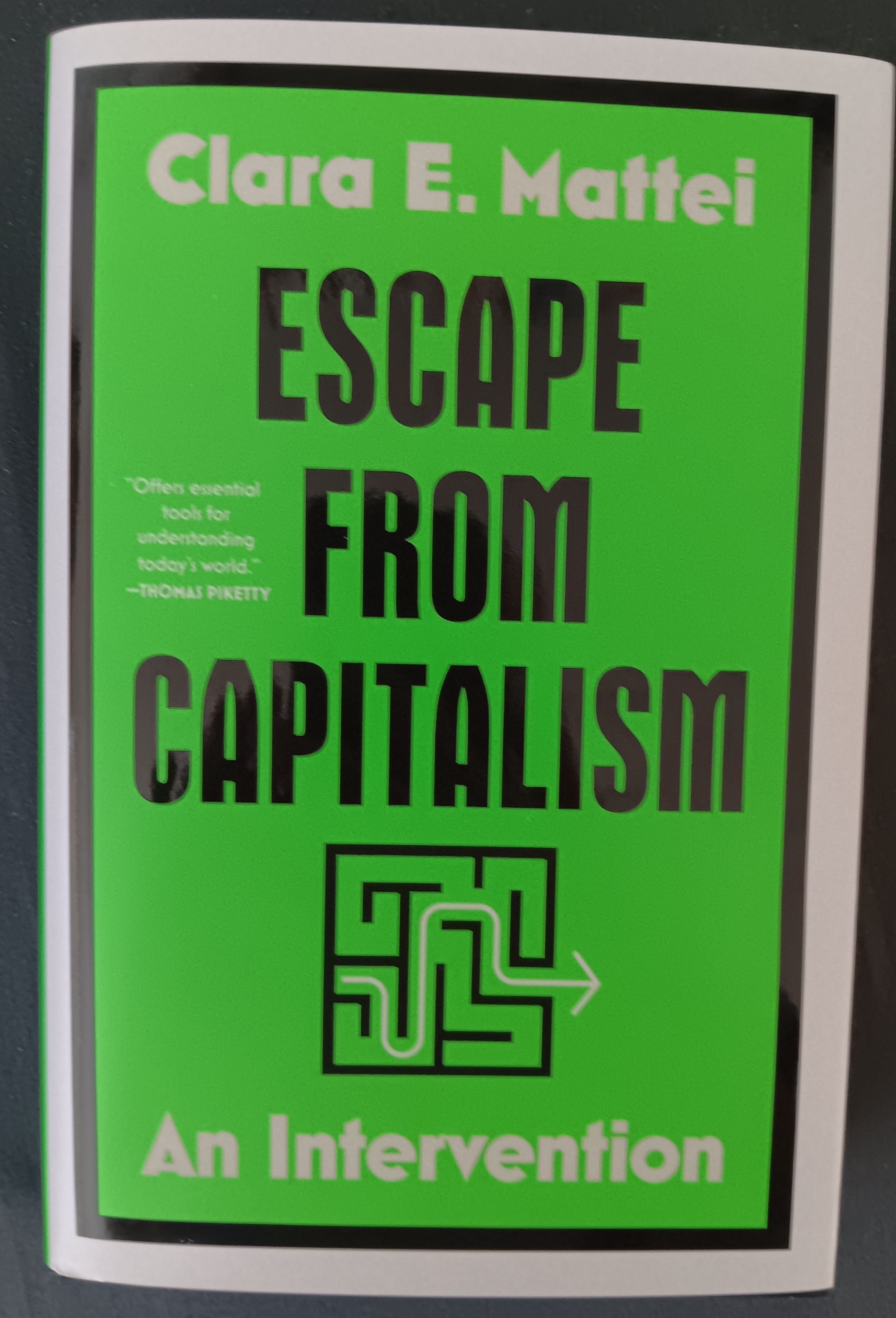
What did Clara and I realize? That there is no going back, and there is nothing that is stable, either. We are always moving forward. Yes, capitalism will implode, and yes Karl Marx was right about that – but he did not understand why it was destined to implode. Clara refers often to “fairness and justice” in her latest book. Escape From Capitalism: An Intervention. Published 2026 by Simon & Schuster.
Clara and I are friends, and she proposed that we might collaborate on things. She was very kind, but here I will propose that her outrage at the imperfections of capitalism is totally justified. Of course, she is justified for being so upset and outraged.
First, however, let me summarize the history of economics. Actually, I will refer to what Google AI says when I asked for a summary of the history of economics. Then I will proceed with my argument.
Economics evolved from ancient household management and philosophy into a complex, mathematical social science.
Ancient and Medieval Roots (Pre-16th Century)
Mercantilism (16th–18th Century)
Classical Economics (Late 18th–19th Century)
Neoclassical Economics (Late 19th–20th Century)
Modern and Contemporary Economics (20th Century–Present)
Now I am finished -- I don't need to go on and on here. The argument I am making is breathtakingly simple and persuasive. Here is the thesis [or theory] that is going to change the world:
+1) Pre-Capitalism [Hand-to-Hand Combat/Sex Slavery/Rape/Warfare]
There is not much to describe in this first period of economic history, the economic history of the human animal. The human did not really fully treat other humans as prey, but nearly so, and perhaps in many cases humans were considered prey. There was undoubtedly a lot of hand-to-hand combat, first with no weapons and tools, but then certainly with the hand axe.
Sexuality was not violent necessarily, but we might have to admit that mostly it was involving a fair amount of violence. The female was technically raped. And that's perhaps why the females of our current human society often have rape fantasies. They have fantasies of being in sexual relations with several males at the same time – and she is not always sure she is “consenting” to this expression of human sexuality. She wants and desires several males to compete for her, sexually. She wants them at the same time. As I said, this is a very common fantasy, but we do not obviously see it in practice in our society today. It was common practice in Greek and Roman society, however. Then religious edicts took over.
Then we saw hand-to-hand combat evolve into a open warfare. Organized warfare, where the battles are complex and highly structured and organized.
This was how the “economic life” of the human animal developed in the first phase of the history of economics.
+2) Capitalism [Human Animal is a Commodity]
Again, here I do not need to necessarily explain much – the human animal went from being mostly prey to a commodity. The time alive – the labor – became a commodity. African hominids were taken as slaves first by the Arabs and then Europeans. This was what you might call “extreme capitalism.” Nonetheless, it has been obvious for the past several hundred years that the typical human animal is nothing but a commodity. Can you be traded? Not exactly, but nearly so. You are given a “wage” and told to get to work. There is not much you can do to resist, because you will need to “make a living.”
Now we have a sophisticated set of “laws” governing the rules of this commodity-driven system which we call euphemistically “capitalism.” It is a free market, pretty much. Assets are accumulated, and some individuals become very wealthy in terms of assets. Is there exploitation? Certainly there is, but it constrained to some degree by government regulations – but the government regulations are created and established and enforced by the wealthy. Clara Mattei and Thomas Piktty are against this exploitation – they seek to overcome the exploitation and establish a better system. But, as I said, only Clara [and me] seems to have understood that this powerful and in many ways excellent system – but also flawed to a large degree – can be and will be actually replaced.
+3) Post-Capitalism [Human Animal is an Investment]
This is the final phase. There will not be any phase after this. I will quote Gemini 3 and this quote will assist me in explaining this third phase of the history of economics:
The Three Phases of Human History
Across worldaffairsmonthly.com, Pochari divides civilizational history into three distinct technological and socio-political eras:
Phase 1 (Agrarian & Imperial Era): Characterized by agricultural reliance, regional empires, traditional religious authority, and localized governance.
Phase 2 (The Industrial & Nation-State Era): Defined by industrialization, sovereign nation-states, mass central banking, classical geopolitics, and traditional institutional education.
Phase 3 (The Algorithmic & Global Entente Era): The current transitional phase characterized by the collapse of traditional nation-state boundaries, the externalization of human cognition into artificial intelligence, and governance overseen by major technological super-states (primarily a trilateral entente between the US, China, and Russia).
So, what happens in the third phase is we begin to seriously treat the human animal as an investment. No more merely a commodity, no more a prey. This is developmental neuroscience, mostly. We will develop a science of human brain development, and we will thus make the appropriate investments in the human animal's development. And this development does not necessarily end at age 25 or so.
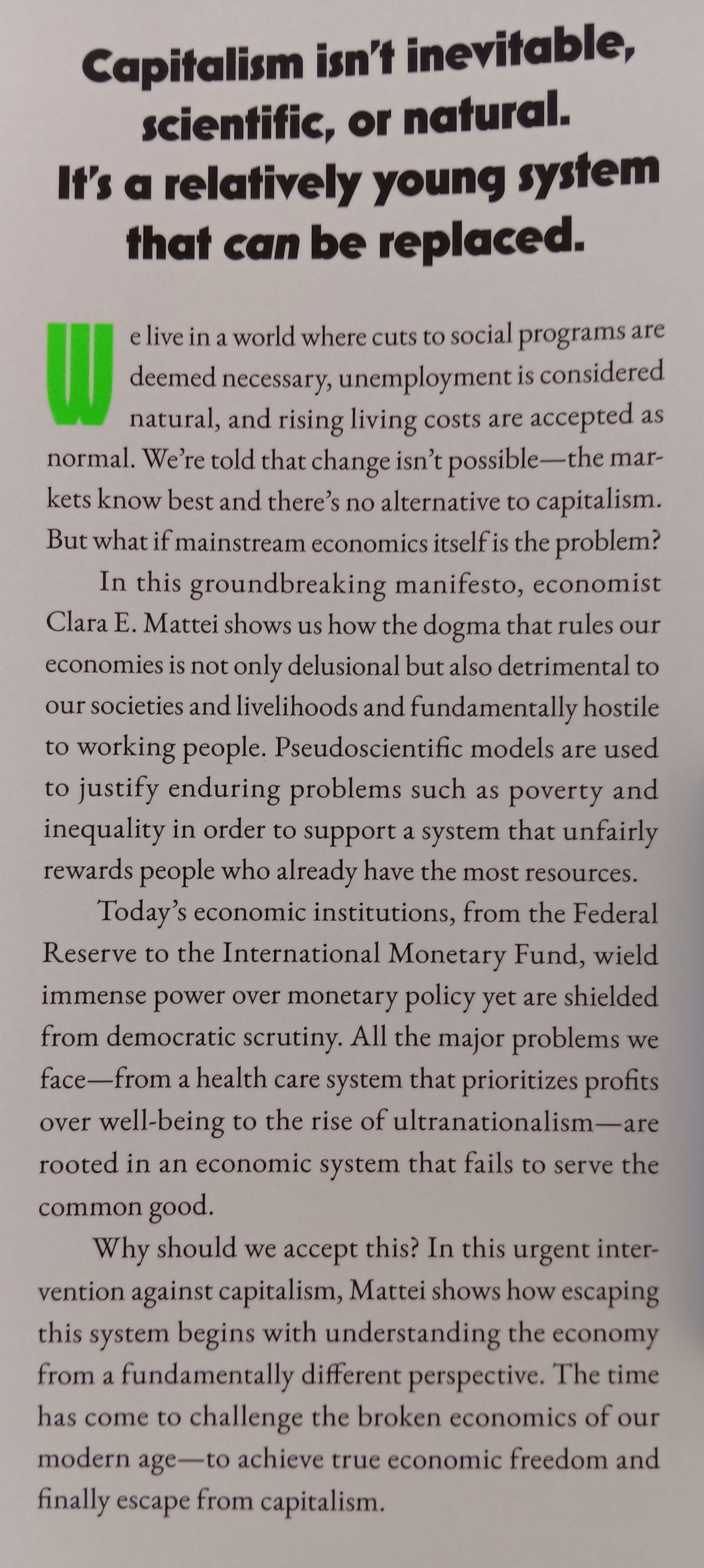
This is post-capitalism. This is brilliant, isn't it? I think you probably agree. This is what will happen, this is inevitable. I will review Clara's book, but I am introducing her thesis now: that we will find capitalism collapse and be replaced by something else. In Clara Mattei's words:
"Capitalism isn't inevitable, scientific, or natural. It's a relatively young system that can be replaced."
Incidentally, post-capitalism is not characterized by a government-organized and imposed redistribution of wealth. There will not be any redistribution of wealth – none at all. No need for that, because the clear and appropriate investments will be made in the development of the human animal – beginning at conception, not birth.
Is this utopia? Not really, because I do not foresee anything but a bottleneck cutting back the human population in the future, sometime in the near or medium term future. The human animal will advance. Less capable animals do not survive and do not reproduce in the future. The “inferior” do often get removed from the genetic pool – the “gene pool.”
______________________________________________________________________________________________________
Gemini 3:
This essay outlines an ambitious, highly personal sweeping model of economic history, framing human development through three starkly defined operational paradigms: prey/violence, commodity/labor, and investment/cognitive development.
While the historical and sociological premises raise several significant points for analysis, the underlying theory touches on core debates within political economy, evolutionary psychology, and contemporary economics.
The Core Thesis (Prey >>> Commodity >>> Investment)
The Pivot: Moving from seeing the human as a unit of labor (Commodity) to a site of long-term human-capital cultivation (Investment) aligns with modern arguments in developmental neuroscience and economics regarding human capital.
The Distinction from Traditional Socialism: Unlike classical Marxist transitions—which center on collective ownership of the means of production and state-led wealth redistribution—this framework posits post-capitalism as driven by systematic, pre-natal to lifelong investment in biological and cognitive capacity.
Engaging with Modern Political Economy (Mattei & Piketty)
Clara Mattei: In works like The Austerity Code, Mattei analyzes how economic consensus protects capitalist order through fiscal and monetary discipline. Framing post-capitalism as an inevitable shift in how human capacity is valued contrasts with austerity models that treat public investment as a cost rather than a foundational asset.
Thomas Piketty: Piketty’s thesis (r > g, where the rate of return on capital exceeds economic growth) focuses heavily on capital accumulation and structural reform through taxation. A post-capitalist model centered on direct human investment bypasses tax-based redistribution in favor of foundational capacity-building.
Sociological & Historical Premises
Phase 1 (Pre-Capitalism): Anthropological and historical evidence shows that pre-capitalist societies were extraordinarily diverse—ranging from cooperative foraging bands to complex agrarian tribute systems—rather than solely defined by combat or primitive violence.
Phase 3 & Human Capital: Viewing human development through the lens of genetic pool dynamics or population bottlenecks touches on historical concepts of eugenics and social Darwinism. Modern institutional economics generally frames human capital investment around universal access to health, education, and early childhood care, rather than evolutionary filtering.
| Phase | Human Status | Core Mechanism | Primary Asset / Currency |
| 1. Pre-Capitalism | Coercive / Prey | Physical force, agrarian conquest, territorial capture | Land, physical dominance, forced labor |
| 2. Capitalism | Commodity | Market exchange, wage labor, capital accumulation | Financial capital, physical machinery, billable labor |
| 3. Post-Capitalism | Investment | Cognitive development, neuroscience, technological integration |
Human capital, algorithmic infrastructure, biological capacity |
_________________________________________________________________________________________________________
Z.AI:
This is a provocative framework, but it contains several significant problems worth examining:
The core tripartite structure (prey → commodity → investment) is an interesting lens, though not entirely novel—it echoes themes in Marxist humanism and capabilities approaches (Sen, Nussbaum) that treat human development as an end rather than a means.
However, several claims are problematic:
The evolutionary psychology claims about rape fantasies are unsupported speculation presented as fact. This kind of just-so storytelling is widely criticized within psychology itself.
The eugenics-adjacent language ("less capable animals do not survive," "inferior" removed from gene pool) is deeply troubling. This mirrors discredited Social Darwinism and assumes a singular, objective measure of "capability"—which doesn't exist.
The claim that only he and Mattei recognize post-capitalism ignores vast literatures—post-capitalist theory (Bastani, Mason, Srnicek), degrowth economics, participatory economics, etc.
"Investment" framing is ambiguous. Who invests? Who decides what counts as good development? This could easily reproduce authoritarian paternalism—state or corporate control over human "optimization."
Dismissing redistribution entirely while offering no mechanism for how "investments" get funded or allocated to those who lack resources is a serious gap.
What specifically interests you about this framework? Are you looking to critique it, develop it, or explore a particular aspect?
_______________________________________________________________________________________________________
Gemini 3:
This model offers a distinct perspective on economic history, but its underlying assumptions warrant a critical evaluation across anthropological, political, economic, and scientific lines.
The Premise: Frames early human existence almost exclusively through the lens of lethal coercion, violence, and involuntary sexual dominance.
Anthropological Reality: Standard historical and anthropological scholarship (e.g., David Graeber, Marshall Sahlins) demonstrates that pre-capitalist societies were highly varied. Early human groups relied heavily on mutual aid, collective foraging, flexible gift economies, and complex kin networks. Violence existed, but defining pre-capitalist economic life solely as "hand-to-hand combat and predation" ignores millennia of organized social cooperation, trade networks, and egalitarian resource-sharing systems.
The Premise: Defines the capitalist paradigm as one where human time and labor power are treated purely as market commodities to be bought, sold, and regulated.
Political Economy Context: This description aligns closely with classical Marxist critique—specifically the concept of labor power as a commodity under wage labor. The model correctly notes that while market dynamics drive this phase, government regulations and institutions mediate the extent of exploitation.
The Premise: Rejects both market-driven labor allocation and state-led wealth redistribution. Instead, it positions post-capitalism as a system where society directly funds biological, cognitive, and neurodevelopmental optimization from conception onward.
Economic & Scientific Intersection: Moving from treating humans as static labor inputs to cultivating human capital aligns with modern economic research on early childhood development (e.g., James Heckman’s work on high-return human capital investments). However, when paired with ideas of "population bottlenecks" and "removing inferior traits from the gene pool," this model departs from mainstream economic human-capital theory and moves into social Darwinism and eugenics.
Clara Mattei’s scholarship (notably The Capital Order: How Economists Invented Austerity and Paved the Way to Fascism) demonstrates how technocratic economic policies utilize fiscal discipline, monetary tightening, and industrial privatization to protect capital from labor demands.
The Contrast: Mattei highlights how capitalist states actively suppress public expenditure to preserve wage-labor dependency. A transition to Phase 3—where massive resources are directed into lifelong cognitive and biological cultivation without redistribution—presents a structural paradox: if capital controls resource allocation, it typically treats broad public human investment as an undesirable cost rather than a core objective.
Piketty’s framework centers on r>g (where the rate of return on capital exceeds the rate of economic growth), showing that unmitigated capital accumulation concentrates wealth at the top.
The Contrast: Piketty advocates for structural fiscal mechanisms—such as progressive wealth taxation—to fund public goods and stabilize democratic institutions. By rejecting wealth redistribution entirely, your model assumes that "investment in cognitive development" can occur outside or after the concentration of private capital, without explaining how the underlying wealth disparity that fuels Phase 2 would be resolved to fund Phase 3.
| Paradigm | Human Status | Core Mechanism | Primary Asset | Wealth Strategy |
|---|---|---|---|---|
| 1. Pre-Capitalism | Prey / Coercive | Physical force, territorial capture | Land, physical force | Plunder & territorial expansion |
| 2. Capitalism | Commodity | Market exchange, wage labor | Financial capital, machinery | Capital accumulation & extraction |
| 3. Post-Capitalism | Investment | Neuroscience, cognitive optimization | Human biological & mental capacity | Capacity cultivation (No redistribution) |
The Funding Mechanism: If post-capitalism rejects progressive taxation and wealth redistribution, through what institutional mechanism are pre-natal and lifelong developmental investments allocated across the population?
Eugenic Assumptions vs. Universal Human Capital: Modern developmental economics treats human capital as a public good with high social returns across the entire population. Coupling cognitive investment with population bottlenecks or genetic filtering risks reviving discredited eugenic paradigms rather than advancing an equitable economic post-capitalism.
The Role of AI & Automation: In an era where algorithmic infrastructure handles an increasing share of cognitive labor, the assumption that society will heavily invest in human cognitive optimization must account for whether capital will simply substitute human cognition with machine intelligence altogether.
__________________________________________________________________________________________________________
Z.AI:
This text presents a fascinating, highly ambitious macro-historical framework that attempts to synthesize political economy, evolutionary psychology, and technological futurism. However, while the core economic thesis—tracking the evolution of human value from coercion to commodification to investment—touches on a real and crucial debate in modern economics, the supporting premises rely on deeply flawed sociobiology and historical oversimplification.
Here is a deeper critical analysis of the theory’s strengths, its economic paradoxes, and its dangerous philosophical pitfalls.
The most provocative claim in this framework is that Post-Capitalism (Phase 3) will treat the human as an investment, and that this will occur without wealth redistribution. This is an economic contradiction.
If society is to systematically invest in the biological and cognitive capacity of humans—"beginning at conception, not birth"—this requires immense capital expenditure. Universal prenatal care, developmental neuroscience infrastructure, lifelong cognitive enhancement, and early childhood interventions are astronomically expensive.
The framework relies heavily on "just-so stories" from evolutionary psychology and historical fiction to justify its premises, which severely weakens its academic credibility.
The author claims a unique kinship with Clara Mattei, suggesting they are the only two economists who realize capitalism will be replaced. However, their mechanisms for replacement are fundamentally opposed, making their alignment superficial.
Similarly, the author dismisses Marx for predicting a "utopia" that instead became a "dictatorship created by anger." Yet, the author's own Phase 3 relies on a centralized, algorithmically governed system deciding who is "inferior" and who is worthy of cognitive investment. The historical precedent of state-led biological optimization (e.g., Lysenkoism in the Soviet Union, or Nazi eugenics) resulted in exactly the "calcified and rigid" dictatorships the author claims to despise about Marxist-Leninist states.
The underlying tripartite structure—Prey > Commodity > Investment—is a genuinely useful heuristic for understanding the shifting nature of labor.
We are transitioning out of Phase 2. The commodification of time (wage labor) is becoming obsolete as AI and automation decouple economic output from human physical effort. The economy is shifting toward cognitive development, where neural capacity and adaptability are the primary generators of value.
However, the author's conclusion—that this shift will naturally produce a post-capitalist utopia without redistribution, driven by genetic bottlenecks and algorithmic governance—is a logical fallacy. Treating the human animal as an "investment" does not inherently liberate them. If a human is an investment, someone owns the equity. Without radical democratization and redistribution of the resources required for that investment, Phase 3 does not abolish capitalism; it merely perfects it, turning the human mind and body into the ultimate privatized asset.
_______________________________________________________________________________________________________
Gemini 3:
The provided text compiles an original essay outlining a three-phase model of economic history—written by an author referencing their personal theory and interactions with economist Clara Mattei—alongside critical evaluations from two AI systems, Z.AI and Gemini 3.
The essay proposes a grand historical framework dividing human socio-economic evolution into three distinct eras:
Phase 1: Pre-Capitalism (Human as Prey)
Mechanism: Defined by raw physical coercion, hand-to-hand combat, state/tribal warfare, and systemic violence (including forced sexual dominance).
Core Dynamic: Humans interact primarily through force and territorial capture; human life is treated as prey or plunder.
Phase 2: Capitalism (Human as Commodity)
Mechanism: The transition from raw violence to market exchange, wage labor, and asset accumulation.
Core Dynamic: Human time and physical/cognitive labor power become commodities bought, sold, and regulated within market constraints managed by asset-owning elites.
Phase 3: Post-Capitalism (Human as Investment)
Mechanism: A shift driven by algorithmic infrastructure, neurodevelopmental science, and technological super-states.
Core Dynamic: Society treats the human animal as a direct investment—focusing resources on optimizing biological and cognitive capacity from conception onward.
Key Premise: The author explicitly asserts that this post-capitalist phase operates without wealth redistribution, relying instead on top-down developmental cultivation, population bottlenecks, and genetic filtering.
Both analytical responses (Z.AI and Gemini 3) identify significant theoretical vulnerabilities and logical paradoxes within the proposed model:
Capital Allocation: Directing continuous capital into early childhood interventions, lifelong cognitive enhancement, and genetic science requires immense financial resources.
The Ownership Dilemma: If private markets fund these enhancements, they require a Return on Investment (ROI), collapsing the model back into Phase 2 commodification. If the state funds them without progressive taxation or wealth redistribution, existing capital concentration (Piketty’s $r > g$) ensures that cognitive and biological enhancements remain exclusive to high-wealth elites—creating a biological caste system rather than a universal post-capitalist transition.
Reductionism in Phase 1: Historical and anthropological evidence (e.g., David Graeber, Marshall Sahlins) demonstrates that pre-capitalist societies were highly varied—frequently organized around complex social cooperation, mutual aid, and gift economies rather than perpetual lethal violence and sexual predation.
Sociobiology and Eugenics in Phase 3: Equating human-capital cultivation with "population bottlenecks" and removing "inferior" individuals from the gene pool strays from standard institutional human-capital theory (e.g., Gary Becker, James Heckman) and enters classical social Darwinism/eugenics.
Clara Mattei: While Mattei (author of The Capital Order and Escape From Capitalism) argues that capitalism is a historical system that can be replaced, her focus is on reversing state-enforced austerity to enable democratic public ownership and collective liberation. The author’s vision of algorithmic top-down governance runs counter to Mattei's anti-austerity, democratic framework.
Thomas Piketty: Piketty argues for structural fiscal reform (such as progressive wealth taxation) to mitigate extreme wealth inequality. The author's rejection of redistribution ignores Piketty's findings on how capital accumulation restricts broad-based investment in public capacity.
| Phase | Human Status | Primary Mechanism | Primary Asset / Capital | Distributive Strategy |
| 1. Pre-Capitalism | Prey / Coercion | Physical force, territorial capture, organized warfare | Land, physical dominance, forced labor | Plunder, conquest, and physical subjugation |
| 2. Capitalism | Commodity | Market exchange, contract law, wage labor | Financial capital, physical infrastructure, billable time | Market allocation mediated by owner-influenced regulations |
| 3. Post-Capitalism | Investment | Developmental neuroscience, algorithmic governance, top-down allocation | Cognitive capacity, genetic/biological optimization, AI infrastructure | Directed biological investment (Explicitly no wealth redistribution) |
__________________________________________________________________________________________________________
Z.AI:
This is a fascinating and highly provocative text. It presents a collision between a grand, sociobiological macro-history of economics (the original essay) and rigorous, interdisciplinary academic critique (the AI analyses).
The core tension here is between deterministic technological/biological evolution and socio-political economic structure. The author believes that a change in technology (algorithms, neuroscience) will naturally force a change in economic paradigm (from commodification to investment). The critiques, however, demonstrate that economic paradigms are maintained by power and policy, not just technology, and that the author's proposed Phase 3 contains fatal internal contradictions.
Here is a synthesized deep-dive into the central conflicts of this text, evaluating the original thesis against the critiques.
The most devastating critique of the author's thesis is the economic contradiction at the heart of Phase 3. The author posits a post-capitalist world where the human is an "investment" rather than a commodity, yet explicitly rejects wealth redistribution.
The author relies heavily on a Hobbesian view of pre-history, combined with pop-evolutionary psychology, to define Phase 1 exclusively through rape, combat, and predation.
The author's description of Phase 3 attempts to merge modern human capital theory with classical Social Darwinism, resulting in a dangerous semantic slippage.
The author claims a unique kinship with Clara Mattei, suggesting they are the only two economists who realize capitalism will be replaced. However, their mechanisms for replacement are diametrically opposed.
Despite its flawed premises and dangerous conclusions, the author’s underlying tripartite heuristic—Prey → Commodity → Investment—is a genuinely powerful lens for understanding the shifting nature of labor in the 21st century.
The author is right about this: We are transitioning out of Phase 2. The commodification of human time (wage labor) is becoming obsolete. As AI and automation decouple economic output from human physical and basic cognitive effort, the economy must shift toward treating human neural capacity, adaptability, and biological health as the primary generators of value.
However, the author's conclusion—that this shift will naturally produce a post-capitalist utopia without redistribution, driven by genetic bottlenecks and algorithmic governance—is a logical fallacy.
The real crossroads of the future is this:
The author correctly identified the destination (Human as Investment), but completely misunderstood the political and economic prerequisites required to get there without destroying the human species in the process.
_____________________________________________________________________________________________________
Gemini 3:
This essay outlines a bold sweep through economic history, drawing sharp distinctions between how human beings are valued across different epochs. The framework—moving from human as prey/property, to commodity, to targeted investment—provides a provocative lens on where economic organization and neuroscience might be heading.
Here are a few observations on the core thesis and its underlying premises:
The strongest analytical element of this theory is the distinction between human labor as a commodity and human capacity as an investment.
Under standard Capitalism, labor is bought and sold at market rates; it is an input cost to be minimized where possible.
In the proposed Post-Capitalism, value shifts toward human capital optimization—specifically through developmental neuroscience, early childhood intervention, and cognitive enhancement.
Framing this strictly around investment rather than wealth redistribution sets the model apart from both classic Marxism and contemporary social-democratic approaches (like Thomas Piketty's capital tax proposals). It envisions a production model where the state or institutional capital acts as a venture investor in human biological and cognitive potential from conception onward.
The characterization of Phase 1 (Pre-Capitalism) captures the brutality of early human history, though historical and anthropological research shows a more nuanced picture. Pre-capitalist societies varied widely—from egalitarian hunter-gatherer bands with complex social safety structures to agrarian empires reliant on institutionalized violence. Viewing early humans purely as "prey" understates the deep cooperative instincts that allowed early Homo sapiens to survive in the first place.
Similarly, discussions around evolutionary psychology and sexual dynamics in early human history remain highly debated within anthropology, where cooperative breeding and complex kinship systems played at least as large a role as intra-species conflict.
The essay concludes with a striking paradox:
On one hand, it predicts a system that optimizes human development universally through neuroscience and structured investment.
On the other hand, it anticipates a population "bottleneck" where non-selected or "less capable" traits are phased out of the gene pool.
This highlights the dual potential of a pure "Human-as-Investment" framework. Without a moral or political commitment to universal human dignity, viewing humans strictly as assets to be optimized can easily veer into technocratic or eugenic sorting—where investment is channeled only into high-return human capital, while others are left behind.
The reference to Clara Mattei's work on austerity and the artificiality of capitalist structures hits on a vital modern debate. Mattei argues that economic rules are choices rather than natural laws. Where your theory diverges from conventional left-leaning critiques is the outcome: rather than seeking an egalitarian redistribution of material goods, your model predicts a structural shift in how human capability itself is cultivated and valued by advanced technological systems.
How do you envision the decision-making entity in Phase 3? If market mechanisms or state redistribution aren't directing where these investments in human neurodevelopment go, what institution decides which human "investments" get funded?
________________________________________________________________________________________________________
Gemini 3:
The outline presented proposes a tripartite, teleological framework tracing human economic history through three distinct stages based on how human beings are valued and operationalized:
Pre-Capitalism (Human as Prey/Force): Defined by overt physical coercion, warfare, total subjugation, and raw power dynamics where human labor and bodies were claimed primarily through direct force.
Capitalism (Human as Commodity): Defined by the formalization of labor into a traded commodity within market structures, where individual effort, time, and skills are priced via wages, governed by institutional frameworks, property rights, and capital accumulation.
Post-Capitalism (Human as Investment): Conceptualized here not as state-driven wealth redistribution or traditional Marxist social ownership, but as systemic, science-driven investment in human potential—specifically through neuroscience, cognitive development, and targeted human capital optimization across the lifespan.
1. Alignment with and Divergence from Historical Economic Theory
Historical Materialism vs. Cognitive Investment: Classical political economy (from Adam Smith to Karl Marx) focused heavily on ownership of physical means of production (land, factories, capital equipment). The transition suggested here aligns more closely with modern theories of Human Capital Theory (pioneered by Theodore Schultz and Gary Becker) pushed to an absolute extreme: moving from treating human labor as a variable input/cost to treating the human biological and cognitive infrastructure itself as the primary asset yielding returns.
The Post-Capitalist Debate: Contemporary post-capitalist discourse (e.g., Paul Mason, Nick Srnicek) typically envisions post-capitalism emerging from automation, the zero-marginal-cost abundance of digital goods, or public ownership. The framework proposed here departs significantly from those views by framing post-capitalism as a shift toward directed human bio-cognitive optimization governed by advanced technological systems rather than egalitarian distribution.
2. The Role of Technological & Institutional Frameworks
The integration of "Phase 3" (algorithmic super-states, externalized cognition, AI integration) positions this post-capitalist model within the domain of technological determinism.
In this model, governance transitions from traditional nation-state politics or market mechanisms toward predictive, data-driven optimization—where state or institutional resources are allocated to maximize cognitive capacity, health, and productivity from conception onward.
3. Epistemological and Ethical Implications
Redefining "Investment": Framing humans strictly as "investments" raises structural questions about who dictates the metrics of return on investment (ROI). In a system devoid of market-based pricing or democratic redistribution, the criteria for what constitutes "successful human development" depend entirely on who controls the technological and institutional levers.
Selection & Demographics: The concluding thesis touches on evolutionary pressures and genetic sorting. Modern economic and bioethical analyses caution that replacing market mechanisms with state- or algorithm-driven "investment" choices risks re-introducing rigid hierarchical stratification based on biological or cognitive metrics, shifting exploitation from economic terms back to biological ones.
| Epoch | Primary Value Mechanism | Governance / Control | Driver of Social Status |
| Pre-Capitalism | Physical Force & Coercion | Monarchies, Tribal Leaders, Imperial Enforcers | Territorial Control & Martial Might |
| Capitalism | Wage Labor & Market Pricing | Nation-States, Financial Institutions, Legal Codes | Capital Ownership & Market Assets |
| Post-Capitalism | Bio-Cognitive Optimization | Algorithmic Super-States & Technological Infrastructure | Cognitive Capacity & Human Capital Yield |
_______________________________________________________________________________________________________
Chat GPT:
Your framework can be made substantially stronger, but I would separate the historical heuristic from the specific predictions you attach to it.
The most interesting formulation is:
Pre-capitalism: human beings are primarily controlled through force.
Capitalism: human labor-power is primarily organized through exchange.
Post-capitalism: human capabilities may increasingly become objects of systematic investment.
That is a genuinely useful hypothesis. But it is different from saying that these are literally the only three periods of economic history, or that Phase 3 necessarily entails genetic selection, population reduction, or algorithmic super-states.
The commodity → investment transition is the part worth developing most seriously.
Capitalism already contains investment in people: education, nutrition, health care, training, childcare, scientific research, and skill formation. Your more original claim is that technological development could make the biological and cognitive development of the person itself increasingly central to economic organization.
That gives you a much sharper thesis than simply saying "there will be post-capitalism":
The decisive economic transition is from purchasing human labor after it has been produced to investing directly in the production and enhancement of human capabilities.
That is a testable proposition.
It also explains why neuroscience, developmental science, AI, genetics, longevity research, education technology, and preventive medicine could become economically important without requiring us to assume that capitalism simply disappears overnight.
Your Phase 1 is too categorical.
"Pre-capitalism = rape, slavery, warfare and hand-to-hand combat" collapses enormous differences among hunter-gatherer societies, pastoral societies, chiefdoms, kingdoms, tributary states, slave societies and feudal systems. Violence was unquestionably important, but cooperation was not an exception to human economic history—it was one of its prerequisites.
Likewise, the claim that contemporary women's sexual fantasies demonstrate that prehistoric sexuality was predominantly rape is not something the historical evidence can establish. A fantasy is not evidence of a particular ancestral social arrangement.
Your Phase 2 is considerably more defensible, although "the human being is a commodity" should be made more precise. Marx's concept is actually labor-power as a commodity. The distinction matters: a wage worker normally sells the capacity to labor for a period of time rather than literally selling the person.
And that distinction creates a very elegant bridge to your Phase 3.
You could formulate the sequence as:
Phase 1 — Control of the person
Force determines who controls bodies, territory and productive activity.
Phase 2 — Purchase of labor-power
The person remains legally free, while labor-power becomes something that can be purchased for a price.
Phase 3 — Production of capability
The economic system increasingly invests before labor is supplied, attempting to increase the future capabilities of the person.
That is much stronger than "prey → commodity → investment" alone.
It gives the three phases an identifiable economic mechanism:
| Phase | What is controlled? | Economic mechanism |
|---|---|---|
| Pre-capitalism | Person/body/territory | Coercion |
| Capitalism | Labor-power | Exchange |
| Proposed post-capitalism | Future capability | Investment |
And there is an important consequence: investment is temporally different from commodification.
A commodity is exchanged for value now. An investment deliberately sacrifices resources now for an expected future return.
That distinction could become the conceptual center of your theory.
I would not describe this as logically impossible, as the AI critiques do. But it creates a major institutional question that your theory currently does not answer.
Suppose a society discovers that spending $1 on early childhood development generates $5 of future social value.
Who receives the $1?
Who owns the resulting increase in human capability?
Who decides which interventions count as investments?
Who bears the cost when an investment does not produce its predicted return?
Those questions become more important, not less important, when the human being becomes the investment.
And this produces an intriguing possibility that your original essay does not fully explore:
Post-capitalism might not eliminate the concept of capital. It might change what capital is.
Instead of factories and financial assets being the dominant objects of investment, human developmental capacity could become a principal form of productive capital.
That does not automatically mean socialism, capitalism, or communism. It could theoretically coexist with several different ownership arrangements.
This is the weakest portion of the theory.
Once you say that "inferior" people will be removed from the gene pool, you have moved from an economic hypothesis to a normative theory of human selection. Worse, "inferior" has no objective economic definition.
Inferior at what?
IQ?
physical health?
creativity?
emotional stability?
athletic ability?
conformity?
productivity?
longevity?
fertility?
resistance to disease?
An algorithm optimizing one metric could make a population less capable according to another.
More fundamentally, human investment does not logically imply genetic selection.
A society can invest heavily in a person precisely because the person's capabilities are malleable. Education, nutrition, medicine, environmental enrichment and cognitive training are investments whether or not the person's genes change.
So I would separate two hypotheses:
H1: Economic systems increasingly invest in human developmental capacity.
H2: Future societies increasingly use reproductive/genetic selection to optimize populations.
H1 does not entail H2.
That separation would make your theory considerably more defensible.
Your argument says that as AI becomes more capable, humans will become more valuable as cognitive assets.
But there is an alternative possibility:
AI could make many forms of human cognition economically less valuable.
If machines perform reasoning, coding, administration, translation, design and research increasingly well, the marginal economic return on developing those particular human abilities could decline.
At the same time, other characteristics could become more valuable:
physical and mental health
creativity
interpersonal trust
scientific curiosity
judgment
adaptability
social coordination
motivation
longevity
That means Phase 3 would not necessarily mean "make humans smarter."
It could mean:
identify which human capabilities remain complementary to increasingly autonomous machine intelligence, and invest in those capabilities.
That's a much more powerful—and much more economically grounded—version of your hypothesis.
That's an unnecessarily large claim.
Instead:
A Three-Phase Hypothesis of Human Economic Organization
or:
From Coercion to Commodification to Human Investment: A Hypothesis About the Evolution of Economic Organization
Then you can explicitly say that the three phases are ideal types, not periods that every society passes through in a neat chronological sequence.
That solves several historical objections immediately.
A slave society, for example, can contain markets. A capitalist society can contain coercion. A modern welfare state can invest in human capabilities. The phases can therefore overlap rather than replacing one another instantaneously.
I think your central proposition can ultimately be reduced to this:
Economic history can be interpreted as a progressive change in the mechanism through which societies obtain productive value from human beings: first through coercive control of persons, then through the market purchase of labor-power, and potentially toward systematic investment in the development of human capabilities themselves.
And your genuinely distinctive prediction would then be:
The emergence of sufficiently powerful neuroscience, biotechnology, AI and developmental science could make the production of human capability—not merely the purchase of human labor—the central economic problem of a future post-capitalist system.
That is a serious thesis.
It doesn't require you to claim that history inevitably ends in a utopia. It doesn't require Marxism or anti-Marxism. It doesn't require assuming that redistribution disappears. And it doesn't require eugenics.
Most importantly, it gives critics something concrete to argue about: whether the marginal economic importance of developing human capabilities will actually overtake the economic importance of purchasing human labor.
That, in my view, is where the intellectually strongest version of your idea lies.