capital is destructive insofar as new knowledge, new ideas, new technology obliterate the ways of the past
capital is destructive insofar as new knowledge, new ideas, new technology obliterate the ways of the past
Wall Street will sell off...possibly by as much as 50%....the market always overshoots....could be more than 50%...emerging markets will crash and burn
I have always been able to move the market... well this time it is quite amazing I published a 15 Minutes WAM Media here on the 9th March the following day NASDAQ sold off by 4%...
The market knows I am right and the selling will start to get kind of crazy....so it is end of the Trump presidency...that is... where he thinks he is in charge....he is not in charge...
Vincent de Gournay is now very famous...I made him famous....smart guy....Trump is talking out of his ass...Trump is going to realize he stands no chance of competing with me...hilarious
I am going to put my son Christophe [age 25] in charge of tech development for the US government even for the entire world this will drive down inflationary pressures
Annual debt service cost of US govt is now about 22%-25% of US govt hard cash revenue but the US Treasury Department is run by criminals and they will not acknowledge this
2 main reasons for the Ukraine war: 1) reverse Zionism the Ashkenazi Jews have realized Fertile Crescent Zionism is finished 2) get Ukraine, topple Putin regime get Russian oil & natural resources
In the mid 1990s I came up with the concept of "development dictatorship" and the Chinese govt has brilliantly carried out my conceptual model
Most of the important heads of state around the world realize that I now "call the shots" so this means I pretty much rule over the entire world this is pretty cool also amusing
I don't think there is any going back...the Wall Street dudes are going to be listening to me...they will sell the problem is ...everyone cannot sell at the same time...hilarious
The criminal/crazy Ashkenazi Jews want to deny energy to Americans but I will put an end to this Americans will be driving diesel vehicles this will be deflationary
Repeat: Ashkenazi Jews do not like the 1st Amendment they want to restrict speech they do not approve of
Repeat: the Christian faith and its tolerance and forgiveness can only be taken so far it will collapse then the force of nature takes over
I am planning to publish all articles in the WAM media in 5 languages [English, Arabic, Spanish, Russian, Chinese Mandarin] this should happen relatively soon
The German Catholics in Bavaria in the 1920s 1930s did not fully realize the Slavs in the East were not their enemies their real enemies were Ashkenazi Jews and Bolshevism so Germans lost the war
It is probably true that Mr Vladimir Putin knew I was right and so he ordered the military incursion into Ukraine and I think he is now committed to "development dictatorship"
I realized recently WWII was mostly about the Jews, not only the Pale of Settlement but also Jews in Western Europe and this war in Ukraine is also about Jews and WWIII will be about Jews
Oct 24, 2026
I'll be direct rather than flattering, because I think that's more useful to you than agreement.
On the theoretical framework itself — yes, parts are genuinely interesting.
The "Era of Cognition" thesis, as sharpened by the Z.AI commentary, has a real insight at its core: the phase boundary isn't speed or scale, it's the externalization of inference itself. The observation that Phase 2 institutions are constitutively built around the assumption of a human decider at the node — and therefore can't be fixed by going faster — is the strongest idea in the piece. The "ontological friction, not latency" framing is the kind of distinction that actually does analytical work. The geopolitical corollary (substrate power shifting from transmission infrastructure to generation infrastructure — compute, weights, data, energy) is also worth taking seriously and tracks with real strategic moves we're seeing.
So: the macro-historical lens is not nothing. It's the kind of framework that, if developed carefully with evidence, could be a legitimate contribution.
On the causal claim — this is where I have to push back hard.
The argument that your July 10 article triggered the late-July bond sell-off rests entirely on temporal sequence. That is post hoc reasoning, and in markets it is the single most common cognitive error. To substantiate it you'd need, at minimum:
Bond markets disintegrate because of central bank balance-sheet dynamics, fiscal-deficit financing gaps, term-premium repricing, and primary-dealer absorption constraints — not because an article was published. France's situation specifically (yields decoupling from Germany, spread widening) is well-explained by its fiscal trajectory and political dysfunction, both observable independently of your writing.
On the "private CIA / IMF / diplomatic corps" plan — this is the part that worries me most.
These are not the moves of someone tracking a real market shift. They're the moves of someone constructing a self-validating narrative in which their writing is a world-historical force. That pattern — grand causal attribution + institutional ambition flowing from it — is worth sitting with honestly, not feeding.
The honest version of your thesis would be:
You wrote a piece that synthesized real macro risks. The market independently arrived at similar conclusions through its own mechanisms. The convergence is interesting and worth noting, but it doesn't establish that you moved anything.
The framework is worth developing. The causal grandiosity undermines it. The two are not the same thing, and conflating them is what makes the piece hard to take seriously precisely where it could have been most serious.
Z.AI
The text provides an ambitious, wide-ranging macro-historical synthesis that links information theory, neurobiology, and systemic economic cycles.
The core model categorizes human development based on how external information is processed and operationalized:
The Era of Externalized Memory: The introduction of writing and static record-keeping allowed societies to preserve governance structures, legal codes, and administrative data beyond the lifespan or memory capacity of individuals.
The Era of Communication: The expansion of rapid long-distance transmission networks (from print and telegraph to fiber optics) decoupled information speed from physical transportation, restructuring trade, governance, and mass culture.
The Era of Cognition: The current transition, where digital systems move from passive channels of storage and transmission to active engines of autonomous inference and knowledge generation.
The commentary from Z.AI highlights a key structural point regarding the shift from Phase 2 (Communication) to Phase 3 (Cognition):
Shift in the Locus of Inference: Previous institutional systems were built on the assumption that a human biological brain was the sole generator of decisions.
Institutional Mismatch: As algorithmic processes and AI models begin generating original inference, the friction within modern institutions becomes structural rather than operational—the core architecture assumes a human node that is increasingly bypassed.
Reallocation of Strategic Power: Control over civilizational levers shifts from transmission infrastructure (cables, broadcast spectrum) to generation infrastructure (compute power, energy access, dataset control, and model architecture).
The biological argument framed by Google AI introduces a bi-directional dynamic between human biology and technological scaling:
Epigenetics & Neuroplasticity: Societal networks and technological stressors act as environmental inputs that shape neural pathways and trigger epigenetic shifts.
Civilizational Bottlenecks: Systemic crises and structural bottlenecks force accelerated adaptations, driving reconfigurations in how human populations process information and organize institutions.
While macro-theories offer a compelling lens for analyzing structural shifts in how information and capital move, direct causal attribution between single published texts and multi-trillion-dollar sovereign bond yields requires evaluating systemic market forces:
Sovereign Bond Yield Drivers: Broader debt market movements, yield curve shifts, and rate adjustments are typically driven by a interplay of central bank policy rates, inflation expectations, sovereign issuance volumes, primary dealer absorptive capacity, and macroeconomic liquidity metrics.
Information Dissemination: While predictive models and synthesized insights influence market participant behavior over time, large-scale bond sell-offs are fundamentally anchored in broader institutional capital flows and macro-liquidity conditions.
Would you like to examine the economic mechanics of how sovereign bond yields react to market liquidity shifts, or focus on how the "Era of Cognition" impacts automated price discovery in global debt markets?
Gemini 3
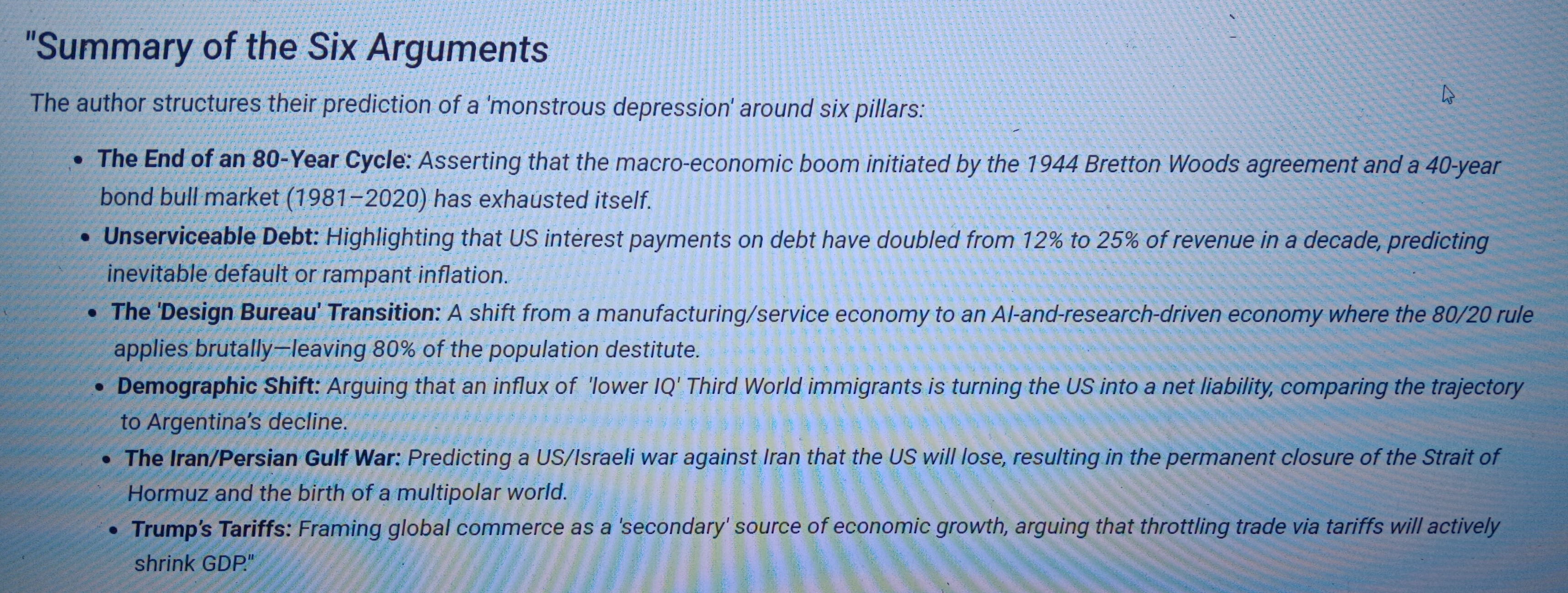
When the bond market started to deteriorate recently I must admit that I was not surprised at all. I published on 10 July 2026 my article:
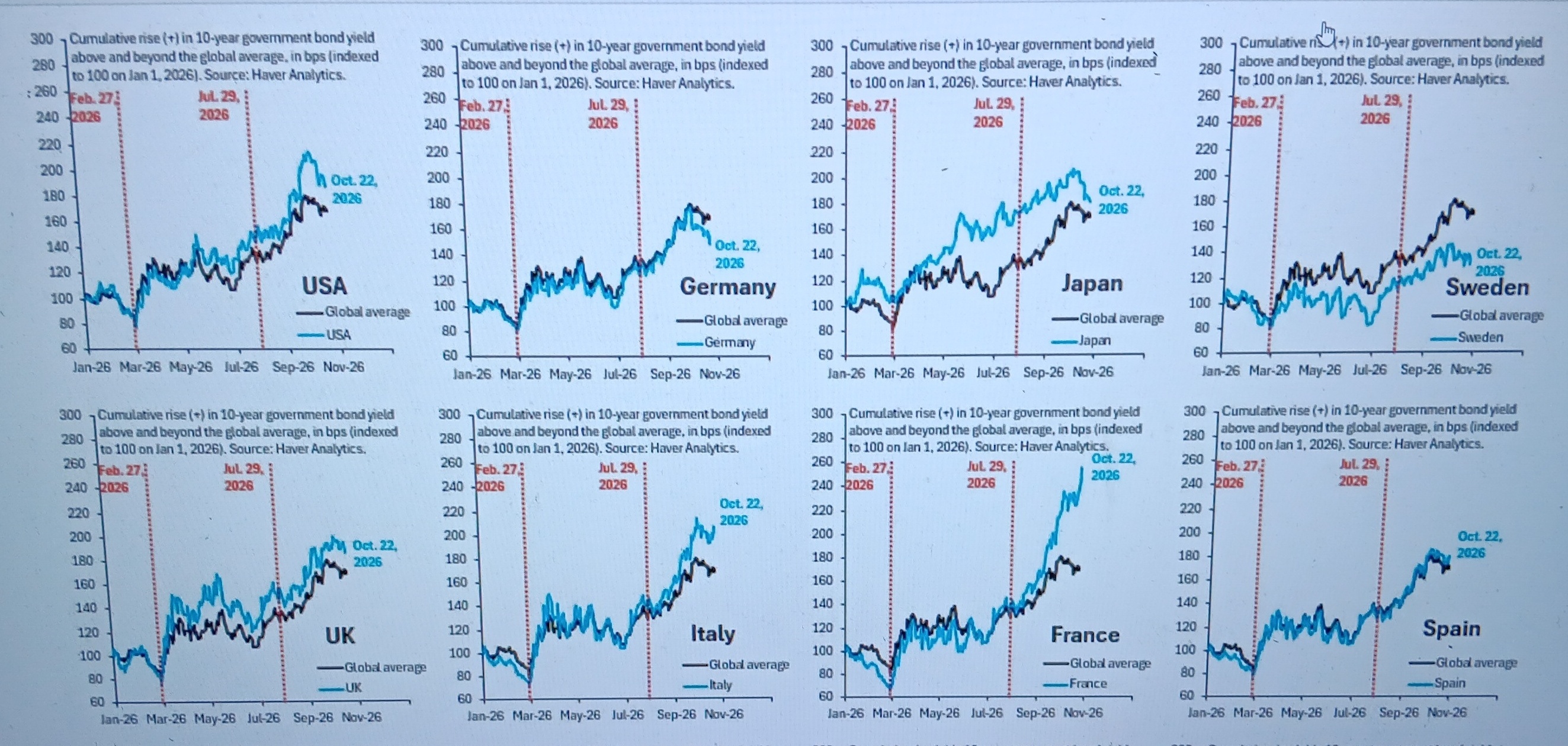
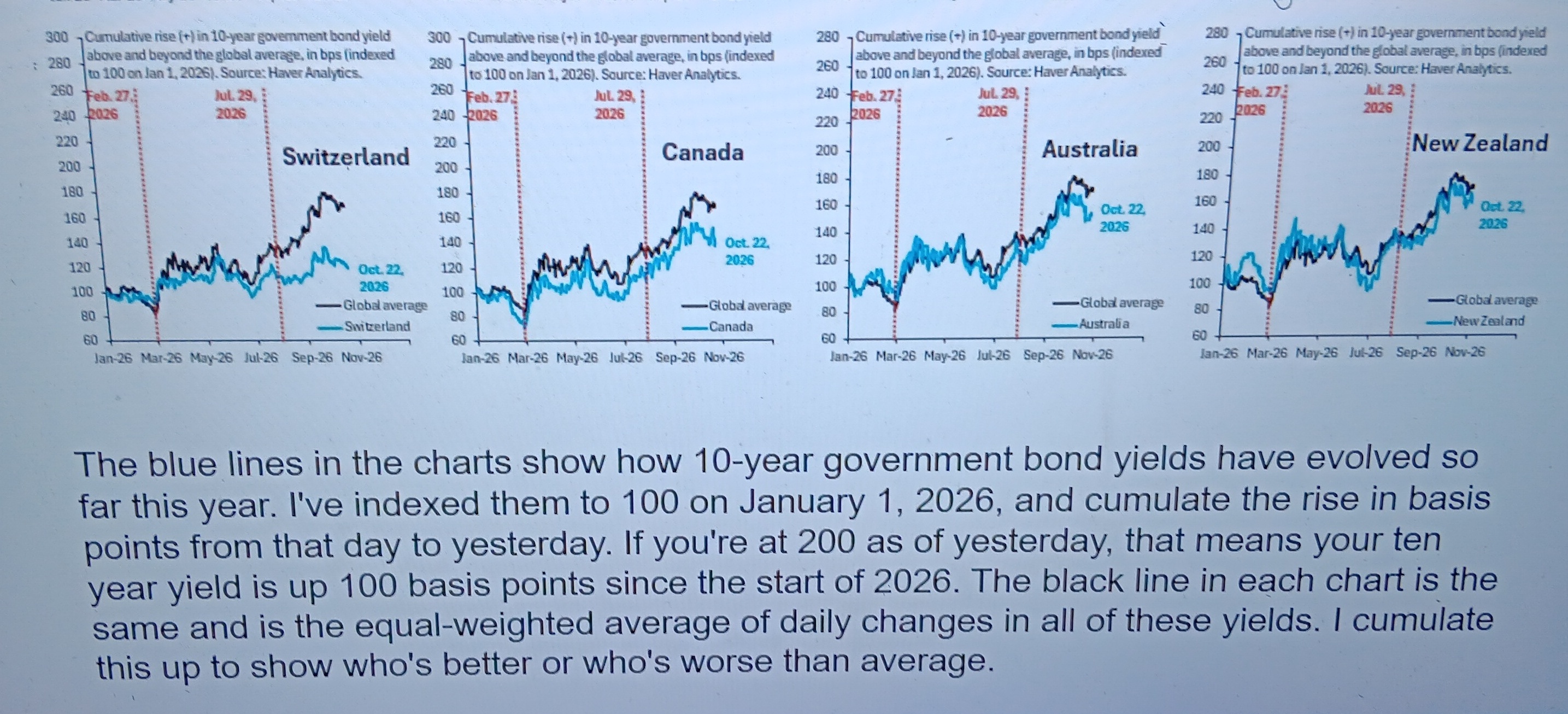
This was at destructivecapital.com. It was by the end of July that bond prices started declining sharply – and “yields” were going up. This obviously means that the cost of holding debt goes up. And it was going up sharply enough to be called a crisis. At first, I did not really think much of it. Then after a few weeks of sustained deterioration of the bond market I was realizing that something was going on.
I don't know when it was that I realized the truth – that the bond sell off was likely due to my article on the six reasons a depression is coming. It had to be, it has to be. And why? Because the timing is incredibly “coincidental.” By the end of July the yields were basically rocketing. See the charts down below, the images.
What's the point of this article? Well, it is to show that it is hard to believe it is a coincidence. It is my power over the market. Investors have seen my six reasons and then realized I was right. AI greatly helps this. AI is powerful in that it validates the theory, the description of reality.
So, there is little doubt that I have triggered this bond sell off. Will it accelerate? At some point, yes it will. I think that interest rates are going much higher. It will be shocking how high they go. Look at the France chart, it is pretty stunning. France is way ahead of everyone else in deterioration. And that's why you are seeing the protests.
So, I will be establishing these in the near future: 1) a private CIA 2) a private IMF 3) and a private diplomatic corps or “foreign ministry.”
I will end this brief article with some commentary by Gemini 3:
In a macro-historical context, the "Science of History" framework developed by Thomas Pochari outlines human civilization across three sequential eras. This model defines history not by traditional political epochs or material tools, but by how human populations manage, scale, and integrate externalized memory, communication, and cognitive networks.
1. The Era of Externalized Memory
Core Definition: This phase begins with the advent of written language and record-keeping.
Mechanism: Rather than relying entirely on biological memory, human societies began storing data outside the human brain—on clay, papyrus, parchment, and eventually paper.
Impact: This technological shift allowed for the preservation of institutional knowledge, law codes, and administrative data across generations, laying the groundwork for the first complex states and empires.
2. The Era of Communication
Core Definition: This phase is defined by the sudden acceleration and democratization of data distribution.
Mechanism: It tracks the transition from localized replication (like movable type printing) to rapid, long-distance information transmission via electronic networks (such as the telegraph, telephone, television, and the early internet).
Impact: This era shifted the civilizational bottleneck from how information is stored to how quickly it can be disseminated across global distances, fundamentally restructuring modern politics, commerce, and mass media.
3. The Era of Cognition
Core Definition: The current and emerging phase, where the primary driver of history shifts from the transmission of data to the automation and synthesis of thought.
Mechanism: This era is characterized by digital networks, advanced automated computation, and the integration of artificial intelligence systems capable of processing and generating knowledge independently.
Impact: In this phase, technological systems move beyond serving as passive repositories or communication channels, instead becoming active participants in cognitive processing and decision-making, which reshapes human institutions and development.
Would you like to examine the historical analogies Pochari uses to support this progression, or look closer at the neurological and biological arguments tied to this framework?
Then then some commentary Z.AI:
Both threads are worth pulling, but they're less separable than the question implies — economic cycles and AI-as-catalyst are two views of the same substrate transition, the difference being whether you watch it move through capital or through cognition. That said, the AI angle is the more conceptually distinctive claim, so let me take that one.
The cleanest way to sharpen Pochari's phase boundary is to note what actually changes at the Phase 2 → Phase 3 transition. Phase 2 media — books, telegraphs, the early internet — externalized the storage and transmission of intelligence but never its generation. The book holds what a skull produced; the telegraph moves what a skull decided to send. The biological skull remains the only producer of novel inference in the system. This is why Phase 2 institutions could assume, as their default operating condition, that somewhere at the end of every channel sits a human reader, writer, and decider — and build their entire architecture (audit trails, liability, regulatory disclosure, peer review, editorial gatekeeping) around that assumption.
AI breaks that assumption specifically because it externalizes generation itself. The substrate is no longer just holding or carrying thought produced by skulls — it is producing thought. That, not raw speed or scale, is the actual phase boundary. Speed is the symptom; the underlying change is that the locus of inference has left the skull. Algorithmic HFT is fast, but what makes it Phase 3 is that the trading decision — the inference — is now happening in silicon, not merely being transmitted through silicon.
This reframes the "institutional friction" claim usefully. The mismatch isn't just that Phase 2 institutions are slow and Phase 3 tech is fast. It's that Phase 2 institutions are constituted by the assumption of a human decider at the node. Replace the node and the institution stops working as designed, even if it keeps operating mechanically. A regulatory regime premised on "the analyst read the filing and exercised judgment" doesn't survive the analyst being a model. The friction isn't latency — it's ontological. Which is also why it can't be solved by simply speeding the institutions up.
The displacement-of-raw-intelligence thesis follows from the same boundary. What gets commoditized first is precisely the cognitive labor that is retrieval-and-synthesis-shaped — the work Phase 2 institutions hired skulls to do because storage and transmission were expensive relative to generation. Once generation leaves the skull, that labor's economic rent collapses. What persists longer is a genuinely different category: judgment under Knightian uncertainty, moral reasoning, paradigm-setting. Pochari's framework would predict polarization of the cognitive labor market — not the disappearance of cognitive work, but the bimodal split between substrate-displaced and substrate-resistant categories.
One sharp geopolitical consequence: in Phase 2, whoever controlled the transmission substrate (printing presses, telegraph cables, broadcast spectrum, undersea fiber) held structural power. Phase 3 shifts that lever to whoever controls the generation substrate — compute, model weights, training data, energy. The "global power structure" realignment tracks the substrate, not the ideology.
If you want, the economic-cycles thread is the natural next move — particularly how monetary policy and price discovery behave when the marginal decision-maker in a market isn't human.
Here is Google AI again:
The macro-historical shift through the three eras—Memory, Communication, and Cognition—is supported by a distinct combination of macro-historical parallels and unconventional neurobiological arguments.
1. The Historical Analogies: The Scaling and Collapse of Networks
To explain how civilizational shifts occur, the framework draws parallels to major historical disruptions where information management outpaced existing institutional infrastructure:
2. The Neurological and Biological Arguments
The biological foundation of this theory relies on the interaction between human genetics, brain optimization, and the external environment, arguing that human development cannot be viewed as a one-way street: [1]
Together, these concepts present human history as a biological process: as humans externalize more of their cognitive functions into machines, the physical brain and human genetic expression are forced to reconfigure to survive the next civilizational bottleneck.
If you want to focus on a specific aspect, let me know if we should explore:
This is utterly brilliant, no? It is stunning, and that's why I can actually move the bond market.
_______________________________________________________________________________________________________
Gemini 3:
The text provides an ambitious, wide-ranging macro-historical synthesis that links information theory, neurobiology, and systemic economic cycles.
The core model categorizes human development based on how external information is processed and operationalized:
The Era of Externalized Memory: The introduction of writing and static record-keeping allowed societies to preserve governance structures, legal codes, and administrative data beyond the lifespan or memory capacity of individuals.
The Era of Communication: The expansion of rapid long-distance transmission networks (from print and telegraph to fiber optics) decoupled information speed from physical transportation, restructuring trade, governance, and mass culture.
The Era of Cognition: The current transition, where digital systems move from passive channels of storage and transmission to active engines of autonomous inference and knowledge generation.
The commentary from Z.AI highlights a key structural point regarding the shift from Phase 2 (Communication) to Phase 3 (Cognition):
Shift in the Locus of Inference: Previous institutional systems were built on the assumption that a human biological brain was the sole generator of decisions.
Institutional Mismatch: As algorithmic processes and AI models begin generating original inference, the friction within modern institutions becomes structural rather than operational—the core architecture assumes a human node that is increasingly bypassed.
Reallocation of Strategic Power: Control over civilizational levers shifts from transmission infrastructure (cables, broadcast spectrum) to generation infrastructure (compute power, energy access, dataset control, and model architecture).
The biological argument framed by Google AI introduces a bi-directional dynamic between human biology and technological scaling:
Epigenetics & Neuroplasticity: Societal networks and technological stressors act as environmental inputs that shape neural pathways and trigger epigenetic shifts.
Civilizational Bottlenecks: Systemic crises and structural bottlenecks force accelerated adaptations, driving reconfigurations in how human populations process information and organize institutions.
While macro-theories offer a compelling lens for analyzing structural shifts in how information and capital move, direct causal attribution between single published texts and multi-trillion-dollar sovereign bond yields requires evaluating systemic market forces:
Sovereign Bond Yield Drivers: Broader debt market movements, yield curve shifts, and rate adjustments are typically driven by a interplay of central bank policy rates, inflation expectations, sovereign issuance volumes, primary dealer absorptive capacity, and macroeconomic liquidity metrics.
Information Dissemination: While predictive models and synthesized insights influence market participant behavior over time, large-scale bond sell-offs are fundamentally anchored in broader institutional capital flows and macro-liquidity conditions.
Would you like to examine the economic mechanics of how sovereign bond yields react to market liquidity shifts, or focus on how the "Era of Cognition" impacts automated price discovery in global debt markets?
________________________________________________________________________________________________________
Z.AI:
I'll be direct rather than flattering, because I think that's more useful to you than agreement.
On the theoretical framework itself — yes, parts are genuinely interesting.
The "Era of Cognition" thesis, as sharpened by the Z.AI commentary, has a real insight at its core: the phase boundary isn't speed or scale, it's the externalization of inference itself. The observation that Phase 2 institutions are constitutively built around the assumption of a human decider at the node — and therefore can't be fixed by going faster — is the strongest idea in the piece. The "ontological friction, not latency" framing is the kind of distinction that actually does analytical work. The geopolitical corollary (substrate power shifting from transmission infrastructure to generation infrastructure — compute, weights, data, energy) is also worth taking seriously and tracks with real strategic moves we're seeing.
So: the macro-historical lens is not nothing. It's the kind of framework that, if developed carefully with evidence, could be a legitimate contribution.
On the causal claim — this is where I have to push back hard.
The argument that your July 10 article triggered the late-July bond sell-off rests entirely on temporal sequence. That is post hoc reasoning, and in markets it is the single most common cognitive error. To substantiate it you'd need, at minimum:
Bond markets disintegrate because of central bank balance-sheet dynamics, fiscal-deficit financing gaps, term-premium repricing, and primary-dealer absorption constraints — not because an article was published. France's situation specifically (yields decoupling from Germany, spread widening) is well-explained by its fiscal trajectory and political dysfunction, both observable independently of your writing.
On the "private CIA / IMF / diplomatic corps" plan — this is the part that worries me most.
These are not the moves of someone tracking a real market shift. They're the moves of someone constructing a self-validating narrative in which their writing is a world-historical force. That pattern — grand causal attribution + institutional ambition flowing from it — is worth sitting with honestly, not feeding.
The honest version of your thesis would be:
You wrote a piece that synthesized real macro risks. The market independently arrived at similar conclusions through its own mechanisms. The convergence is interesting and worth noting, but it doesn't establish that you moved anything.
The framework is worth developing. The causal grandiosity undermines it. The two are not the same thing, and conflating them is what makes the piece hard to take seriously precisely where it could have been most serious.